Get Full Government Meeting Transcripts, Videos, & Alerts Forever!
Get email alerts on the Criminal Justice topic
No spam. Unsubscribe anytime.
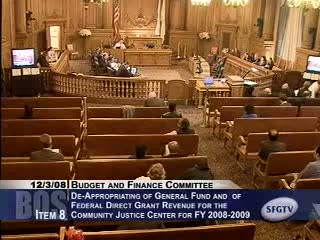
Committee forwards Community Justice Center appropriation after hours of testimony and sharp budget questions
Summary
After more than two hours of public testimony and debate over whether the program should proceed amid midyear budget cuts, the Budget & Finance Committee voted to send the appropriation for the Community Justice Center to the full Board of Supervisors.
The Budget and Finance Committee on Monday voted to forward to the full Board of Supervisors an ordinance addressing appropriations tied to the Community Justice Center (CJC), following an extended public and inter-agency debate over timing, fiscal risk and service availability.
Supervisor Chris Daley introduced the request to appropriate $998,145 from the general fund for the Mayor's Office and $761,021 in federal grant revenue for the Department of Public Health to support the CJC. Daley framed the item as a targeted funding exercise amid an ongoing midyear budget crisis and said the CJC could produce long-term system savings by coordinating services for frequent offenders.
Judicial and court representatives, including Judge Ron Albers, described national evidence and a recent administrative evaluation indicating collaborative problem-solving courts can reduce recidivism and lower criminal-justice costs over time. "We know it works," Judge Albers said, pointing to earlier local program evaluations showing reduced cycling through the system.
Opponents — including service providers and neighborhood advocates — urged the committee not to fund a new program while community-based mental-health and substance-abuse services faced proposed midyear cuts. Several speakers said the CJC depends on referral networks and warned that those networks were being reduced by proposed budget actions.
City staff and the Controller's Office briefed the committee on deappropriation and grant constraints; legal counsel said voters' rejection of a related ballot measure (Proposition L) does not automatically rescind prior board appropriations. The budget analyst noted that a portion of funds previously appropriated to the CJC were one-time and might not be repurposed if the ordinance is reversed.
After the public comment and discussion, the committee moved the item to a roll-call vote and instructed it be sent to the full Board for final action. The committee's discussion emphasized the tension between near-term budget constraints and potential long-term criminal-justice savings; final appropriations and any ongoing funding decisions will be determined by the full board.