Get Full Government Meeting Transcripts, Videos, & Alerts Forever!
Get email alerts on the Economic Development topic
No spam. Unsubscribe anytime.
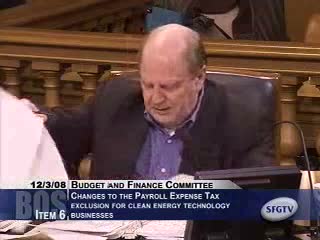
Supervisors advance expansion of cleantech payroll tax exclusion to include smaller firms and installers
Summary
The Budget & Finance Committee voted to send an amended ordinance expanding San Francisco's cleantech payroll tax exclusion to the full board, lowering the employee threshold and broadening qualifying activities after staff added clarifying language and controls to limit fiscal risk.
The Budget and Finance Committee on Monday recommended that the Board of Supervisors consider an ordinance that would broaden San Francisco's payroll tax exclusion for clean-technology businesses to include smaller firms and certain installers.
The amendment, introduced by Chair Jake McGoldrick, would lower the minimum employee threshold for eligibility and extend the definition of qualifying activities to include additional clean-energy, energy-efficiency and advanced-materials work. Jennifer Matz, managing deputy director of the Office of Economic and Workforce Development, told the committee the changes aim to help early-stage cleantech startups and local solar-installation businesses remain competitive in the Bay Area.
David Pascal of the Department of the Environment described the categories the ordinance would cover, including renewable-energy production, energy storage and distribution, energy-efficiency retrofit products, advanced materials and certain carbon‑market services. Pascal said the intent was to target firms whose core business is clean technology rather than incidental or ancillary work.
Ted Egan of the Controller's Office said the department had previously flagged the draft as potentially broad, but that recent revisions addressed most concerns and reflected the controller's recommended risk-mitigation measures. "Having reviewed the draft changes from today," Egan said, "I would say that essentially all of our concerns and all of our recommended risk mitigation measures have been reflected in the latest draft."
Supervisors questioned how the city would verify that businesses meet the activity thresholds and whether the exemption could create a material payroll-tax loss. Staff said the ordinance would include a percentage-of-activity test and additional controls, and the treasurer's office offered a technical amendment to align the small-business exemption threshold with Proposition Q indexing.
Several clean-technology entrepreneurs and advocates spoke in favor of the change during public comment. Peter Flaxman of Keiko Solar said his San Francisco headquarters has benefited from the existing program and supported expanding eligibility to retain and grow local jobs. Brian Payer of the Cleantech Open and other startup representatives described the exemption as helpful to very small, early-stage firms.
The committee voted to send the amended ordinance to the full board with the staff and controller-recommended changes. The item will return to the board for a final vote.