Get Full Government Meeting Transcripts, Videos, & Alerts Forever!
Get email alerts on the Land Use Pdr Replacement topic
No spam. Unsubscribe anytime.
Rules Committee advances amended PDR replacement and conditional‑use measure, but supervisors and stakeholders press for more study
Summary
The Rules Committee signed off on several amendments to a proposed ballot ordinance requiring conditional‑use review and replacement space for PDR, arts and institutional/community uses, adopting grandfathering and zoning changes while continuing the item for further work and eliciting objections from Supervisor Malia Cohen and developer and labor representatives.
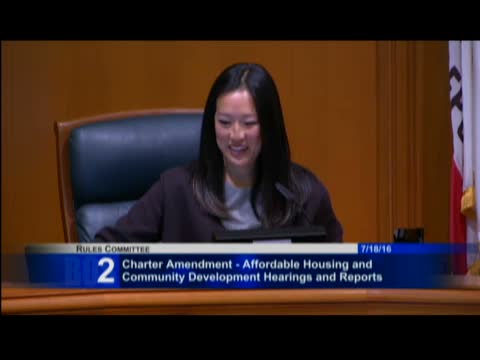
The San Francisco Board of Supervisors’ special Rules Committee advanced, with amendments and a continuation for further work, a proposed ballot ordinance that would require conditional‑use authorization and replacement space when production, distribution and repair (PDR), arts or institutional/community uses are converted. The committee met July 18, 2016, and accepted several sponsor‑proposed changes while stakeholders and some supervisors urged a legislative approach and more analysis.
The ordinance proposed for submission to voters would add a conditional‑use (CU) trigger for conversions of PDR, arts and institutional/community uses in the Mission, Eastern SoMa and Western SoMa area plans (and Central SoMa if adopted) and would require replacement space in enumerated zoning districts. Planning staff and the sponsor outlined tiered replacement ratios and exemptions during the hearing. April Vanarasian Ng of Supervisor Kim’s office said the amendments clarify that replacement space must match the prior non‑temporary use (so a prior PDR would be replaced by PDR) and that short‑term ‘‘pop‑up’’ uses would not erase a prior PDR use for replacement purposes.
Committee members adopted changes that remove a lightly used industrial category from some requirements and lower a replacement ratio in certain zones from 0.75 to 0.5. The committee also accepted an exemption for the South Beach Marina affordable‑housing project and adopted a grandfathering amendment exempting projects whose environmental evaluation applications were submitted on or before June 14, 2016; the committee accepted those amendments without objection. Deputy City Attorney John Givner cautioned the committee that not all proposed changes (for example, adding 100% affordable‑housing allowances in PDR zones) would be within the scope of what the board may do for a ballot measure.
Supervisor Malia Cohen voiced strong concerns about process and timing. She said the measure had not had adequate community review and analysis and called the timing ‘‘undemocratic’’ given the Eastern Neighborhoods plan history. ‘‘We don’t make other planning changes this way,’’ Cohen said, urging the sponsor to pursue legislative or interim‑control options and asking staff to analyze whether replacement obligations — in particular a proposed 40% capture for some pipeline projects — are feasible.
Developers and labor representatives told the committee the proposal, as drafted, could disrupt projects already under way. Mohammed Athiri of Access Development Group said his 2675 Folsom Street project submitted an environmental application on Oct. 10, 2014, and warned the draft grandfathering rules would prevent the project from proceeding without relief. Adrian Simi of Carpenters Local 22 said changing rules mid‑stream would undermine labor commitments and apprenticeships. Kate Sophos of SFMADE urged more data and stakeholder engagement, and warned against allowing housing broadly into PDR zones.
Planning staff clarified that the CU requirement as written would be triggered by any conversion or displacement within the stated plan areas but that the replacement‑space obligation would apply only in the enumerated zoning districts. Staff pointed the committee to an Eastern Neighborhoods Monitoring Report draft as the most up‑to‑date study of local conditions.
After adopting the amendments noted above and adding findings (including a read‑in of the Northern California Grantmakers report on nonprofit space), the committee voted 2–1 to add language referencing Central SoMa (if adopted) to the areas covered by the controls; Supervisors Marr and Tang voted aye, Supervisor Cohen voted no. The committee moved the amended item forward and continued Item 3 to a special Rules Committee meeting later that week for additional work on small‑site exemptions, historic‑building language and further drafting on the interchangeability/like‑for‑like replacement language.
Next steps: the item will be revisited at the special Rules Committee meeting and, if acted on, would be placed on the ballot for the Nov. 8, 2016 election. The committee asked the sponsor and city attorney’s office to resolve open scope questions (including how affordable‑housing projects should be treated) and to provide clearer draft language before the next hearing.