Get Full Government Meeting Transcripts, Videos, & Alerts Forever!
Get email alerts on the Public Advocate Charter topic
No spam. Unsubscribe anytime.
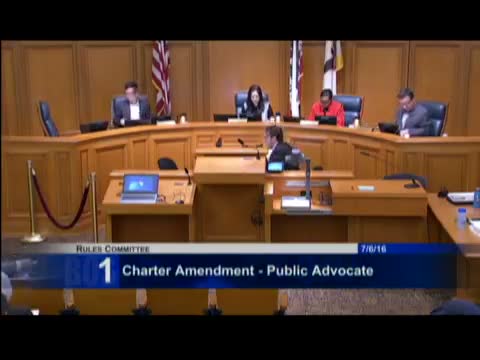
Supervisors debate creation of elected public advocate, committee adopts amended versions and continues measure
Summary
The Rules Committee considered a charter amendment to create an elected public advocate with powers to review city programs, make appointments in some cases, and conduct systemic oversight. Members adopted multiple drafting changes, duplicated the file into two versions and continued the item for further refinement and term‑limit language.
Supervisor David Campos introduced a first draft of a charter amendment to create an elected public advocate for the City and County of San Francisco, saying the office would “have an advocate for the people of San Francisco” to address cases when city services fail or when government is unresponsive. Campos told the Rules Committee he and staff had worked with the controller’s office, civilian‑oversight advocates, labor leaders and other stakeholders to craft five principal changes to the original proposal.
The measure as amended would leave the city’s whistleblower program housed in the controller’s office while giving the public advocate limited responsibility to address whistleblower complaints about inefficient or inadequate city services. It would keep the Office of Citizen Complaints (OCC) under the police commission while giving the public advocate a role in appointing the OCC director (as revised during drafting). The proposal also would give the Civil Service Commission authority to set the public advocate’s salary, add recommended staffing guidelines (one constituent‑service staffer and one investigator per supervisorial district as a guideline, not a mandatory set‑aside), and move the public‑advocate election to the next regular or special citywide election rather than a stand‑alone special election.
Public commenters were split. Sean Crew, who has worked on civilian oversight, praised the revisions and urged voters be allowed to decide the measure, saying the office could “fill an important gap” in addressing systemic problems. Unions and building‑trades representatives — including speakers identifying with Local 300 and Carpenters Local 22 — warned that moving oversight or labor enforcement under a citywide elected official could politicize enforcement of worker protections and threatened to oppose parts of the proposal.
Supervisors pressed the author on specifics. Supervisor Malia Cohen highlighted concerns that appointment power for department heads can politicize oversight and pressed to remove appointment authority for OCC and the Office of Labor Standards Enforcement (OLSE); Campos and others argued the amendments as drafted were intended to strike a balance between independence and continuity of existing functions. The Deputy City Attorney circulated revised language after the committee’s recess that added term‑limit language and a four‑year ineligibility clause for certain recently held local elected offices, and removed the public advocate’s explicit appointment power over the OCC director in that draft.
After debate, the committee voted to duplicate the file so two versions would proceed (one reflecting Supervisor Campos’s original amendments and a second that included Supervisor Cohen’s proposed changes). The committee later voted to adopt Cohen’s verbal amendments into both versions for clarity and continued both items to the next Rules Committee meeting (July 14) so the City Attorney could finalize the precise charter language. The Chair said the intent was to give voters a clear choice while ensuring the final measure reflects guardrails intended to limit politicization.
What comes next: the City Attorney will prepare clean text for the two versions and the Rules Committee will revisit the item on July 14 before the measure proceeds to the full Board of Supervisors and — if approved by the board — to the ballot for voters to decide.