Get Full Government Meeting Transcripts, Videos, & Alerts Forever!
Get email alerts on the Police Staffing topic
No spam. Unsubscribe anytime.
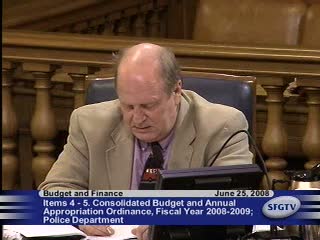
Police staffing debate focuses on academy classes, laterals and civilianization as the committee seeks savings
Summary
Supervisors debated reducing or delaying one police academy class, increasing laterals, and accelerating civilian hires to save roughly $1M–$2M without undermining minimum staffing; the controller recommended converting two civilian hires to personnel‑analysts and a fuller civilianization review by December.
A central portion of the committee’s hearing focused on San Francisco Police Department staffing proposals, training classes and a push to increase civilian hires as a way to return sworn officers to patrol.
Chair Jacob Goldrick proposed eliminating the smallest of three scheduled academy classes (a 40‑recruit class) to save salaries projected at roughly $2 million annualized; supervisors discussed alternatives including delaying the March class by two months (estimated savings ~$650,000), increasing laterals (which require shorter, 8‑week training), or eliminating vacant captain slots (three confirmed vacant captain positions could save roughly $600,000). Controller and budget staff provided the arithmetic and cautioned about overlap with field training capacity and airport‑funded positions.
Police Chief Heather Fong accepted several budget analyst reductions (temporary salaries, professional services, attrition savings) but opposed deleting the assistant chief position and warned that operational certification under Proposition C (minimum staffing) constrains some staffing changes. Controller staff reported that civilianization has added around 45 FTEs since the voter initiative, and recommended converting two proposed civilian hires into personnel‑analysts to accelerate filling civilian slots. The controller’s office also offered to perform a fuller civilianization review and report back by Dec. 1.
Committee members said they wanted to find savings without producing gaps in street policing; several supervisors proposed combining vacancy eliminations with academy schedule adjustments to reach targeted savings without long‑term reductions to the sworn workforce. The committee deferred final action on some police items and asked staff and department leaders to return with refined projections and feasibility analyses.
What’s next: Controller, budget analyst and police department staff will return with a consolidation of options — class scheduling impacts, vacancy reconciliation, and civilianization tradeoffs — at the next meeting.