Get Full Government Meeting Transcripts, Videos, & Alerts Forever!
Get email alerts on the 25 Percent Initiative topic
No spam. Unsubscribe anytime.
Supervisors' 25% minimum inclusionary proposal draws warnings from staff, builders and unions
Summary
A supervisors' initiative that would set a 25% minimum inclusionary requirement prompted staff to present preliminary case studies showing many project types could be financially strained; developers, unions and advocates urged negotiation, grandfathering and a full feasibility study before referendum or ordinance action.
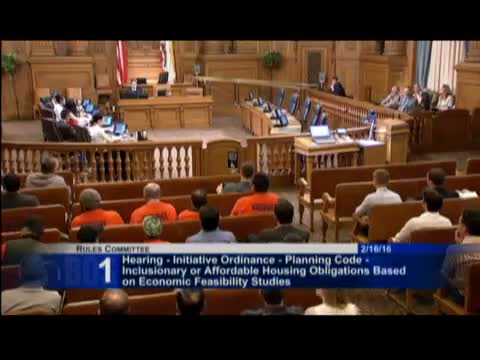
A supervisors' initiative to set a citywide minimum inclusionary requirement of 25 percent (15 percent low-income plus 10 percent for middle-income households) drew sharp questions at a Feb. 16 Rules Committee hearing about whether that number is feasible for many project types.
Sponsors framed the 25% proposal as restoring a higher inclusionary baseline and expanding coverage to middle-income households. Supervisor Jane Kim described the proposal as restoring an on-site 15 percent set-aside at lower-income levels plus an additional 10 percent targeted at working- and middle-income households.
City staff and an economic consultant presented preliminary modeling showing the potential effects. "For this prototype building with 25%, the preliminary analysis showed a 4.9% return on cost, which is substantially below what financial institutions are targeting today," a staff presenter said, summarizing one mid-rise rental case study. Staff estimated that to preserve typical lender return thresholds, land values for that prototype would have to decline by roughly 40 percent, a dynamic that could make existing owners unwilling to sell and projects unfinanceable without subsidies or zoning upzoning.
Developers and small builders testified that a uniform 25% floor threatens many pipeline projects and small neighborhood infill. Mark McDonald of DM Development and other speakers urged robust grandfathering for projects already in entitlement or financing processes. Labor representatives warned that stalled projects would cost construction jobs and expressed support for a negotiated approach to increase affordability without halting work.
The committee took no final policy vote; Supervisor Malia Cohen moved to file the hearing after discussion. Multiple supervisors urged a quick but careful feasibility study and said they hoped both competing ballot measures could be pulled in favor of a negotiated ordinance with technical safeguards such as grandfathering and tiered rates by project type.