Get Full Government Meeting Transcripts, Videos, & Alerts Forever!
Get email alerts on the Pensions Retirement topic
No spam. Unsubscribe anytime.
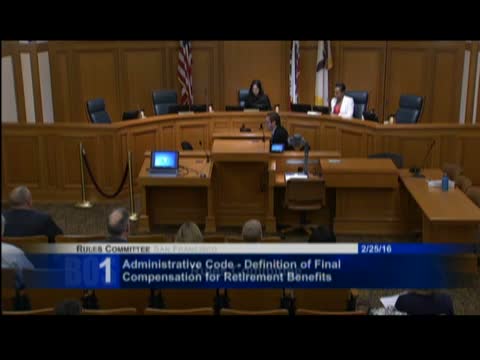
Rules committee advances ordinance to count judges' compensation toward city retirement benefits
Summary
The committee forwarded an ordinance to update the definition of 'final compensation' so that pay earned under the Judge's Retirement System can be considered when calculating San Francisco retirement benefits; Retirement Director Jay Huish said the fiscal impact would be minor and affect a small number of current employees.
SAN FRANCISCO — The Rules Committee on Thursday advanced to the full Board an ordinance amending the administrative code to update the definition of "final compensation" for purposes of San Francisco Employees' Retirement System benefits so compensation earnable under the Judge's Retirement System (JRS) and JRS 2 is included in calculations.
Supervisor Malia Cohen, sponsor of the ordinance, said the measure is intended to fix an outdated definition so that reciprocity is honored and public employees who later serve as judges are not penalized for prior city service. "For years served as a judge, for years served as a prosecutor, we should be able to port over and count towards your retirement benefit," Cohen said.
Retirement Director Jay Huish said the ordinance adopts language similar to CalPERS reciprocity: the city will not count judge service itself toward service credit, but will consider compensation earned while serving as a judge when calculating retirement benefits. Huish told the committee staff identified four current city employees who would be affected by the change and that an actuary's cost report showed a minor fiscal impact. He also said 13 judges over the past 10 years had left city employment to become judges and had since retired and would not be affected.
Superior Court Judge Danielle Douglas testified in support, saying reciprocity helps attract people with diverse public-sector backgrounds to the bench. Judge Harry Dorfman echoed support and framed the change as having negligible impact on city finances while materially affecting affected judges; he characterized the city's exposure as about "3 thousandths of a percent" based on the analysis presented.
The committee approved forwarding the ordinance to the full Board with a positive recommendation; a roll call recorded Cohen and Chair Tang voting 'aye.' The item will appear on the Board agenda for further consideration.