Get Full Government Meeting Transcripts, Videos, & Alerts Forever!
Get email alerts on the Public Information Officers topic
No spam. Unsubscribe anytime.
Supervisors press for cuts and consolidation after Controller report finds 89 —public information— positions
Summary
The Budget & Finance Committee reviewed a Controller's Office inventory that identified 89 positions performing public information duties citywide and debated options including a 25% reduction target, consolidation into the mayor's office, or deletion of vacant posts.
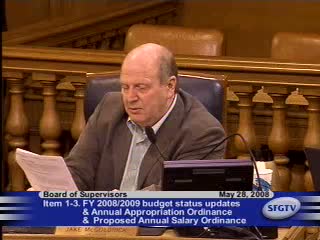
The Budget & Finance Committee of the San Francisco Board of Supervisors on Monday opened a sustained debate after the Controller's Office presented a survey showing 89 city positions performing public information, public relations or governmental affairs duties, with roughly 76 filled and total salaries and benefits of $10,552,000.
Monique Smuda, a budget analyst in the Controller's Office, told the committee: "Through our research, we identified a total of 89 positions of which, 76 are filled." She said those positions' combined salaries and fringe benefits total $10,552,000, of which $2,858,000 is supported by the general fund.
The findings prompted supervisors to question whether the city has a clear definition of what constitutes a public information officer (PIO) and whether some functions could be consolidated or eliminated. "This issue has gotten out of hand," said Supervisor Ross Mercarini, arguing the city should develop a uniform definition and consider reductions where duplicate functions exist. Mercarini and other supervisors pointed to long-standing growth in the number of employees performing communications tasks and urged more aggressive scrutiny than the report alone provides.
A representative from the mayor's budget office said the administration had reviewed the Controller's findings and was "looking to reduce" that set of work by about 25 percent, while acknowledging differences in how departments classify staff. Controller and budget staff cautioned that some enterprise departments—including the Public Utilities Commission and the Municipal Transportation Agency—have larger outreach needs tied to capital projects and service changes and that any cuts should be applied on a department-by-department basis.
Committee members discussed several tools and approaches: (1) deleting unfilled positions (the report identified 11 vacancies), which would not cause layoffs; (2) asking departments to absorb a specified salary savings amount under a "reduction not detailed" provision, leaving it to department management to decide where to reduce; (3) using attrition savings to achieve reductions over time; and (4) consolidating some media-relations work in the mayor's office instead of maintaining separate PIOs in each department.
Budget Analyst Ken Bruce said staff could supply a longitudinal review of departmental FTEs over time, but noted a fully surgical, position-by-position analysis across the entire city would require weeks of work. Several supervisors requested follow-up analysis and indicated they would press the mayor's office and departments for firmer justifications during the remainder of the budget process.
The committee did not adopt a citywide mandate at the meeting; members asked staff to return with more information and signaled interest in consolidation and targeted reductions. The committee's next step is additional department-level review during upcoming budget hearings and follow-up reports from Controller and budget analyst staff.