Get Full Government Meeting Transcripts, Videos, & Alerts Forever!
Get email alerts on the Community Justice Center topic
No spam. Unsubscribe anytime.
Supervisors Hear Court-Led Plan for Tenderloin Community Justice Center; Reserve Release Denied
Summary
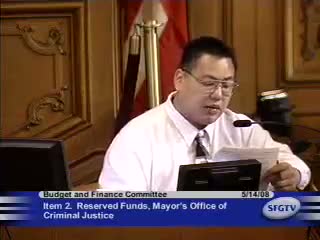
The Board—s Budget and Finance Committee heard detailed presentations and broad public testimony on a proposed Community Justice Center (CJC) to co-locate court operations and social services in the Tenderloin/South of Market. Judges and city departments argued it could reduce jail days and costs; the committee declined to release $500,000 in reserves and deferred the lease decision to the full board.
A court-led proposal to open a Community Justice Center in the Tenderloin dominated the San Francisco Board of Supervisors Budget & Finance Committee—s May 6 meeting, with judges, law-enforcement officials, health staff and residents testifying in favor and opponents warning of budget trade-offs.
Superior Court commissioner Ron Albers and other judicial presenters described the CJC as a problem-solving criminal court "that will handle misdemeanors and nonviolent felonies" co-located with social services so charging and release decisions can be made immediately and treatment engaged on the spot. Albers said the court—s design aims to cut the time defendants spend in custody by presenting on-site release (OR) workups and linking defendants to services that could reduce recidivism and jail bed days.
Department of Public Health deputy director Barbara Garcia and Human Services Agency staff described the on-site services model, saying clinicians and case managers would be housed next to the courtroom and serve both in-custody and walk-in clients. The mayor—s budget office said six direct-service clinicians had been proposed and that the administration had identified roughly $1 million in potential federal funding to help offset operating costs.
The controller—s assessment, issued April 24, 2008 and summarized for the committee, described collaborative courts as an established model and concluded the CJC addresses a real concentration of arrests in a small geographic area: "28% of arrests in the area compared to 10% of the population," the controller—s office reported. The assessment recommended baseline community-opinion testing and cautioned that procedures, referral protocols and the program—s relationship to existing "community court" operations required clearer definition before full implementation.
Supervisors raised fiscal and operational questions: would the CJC duplicate, supplant or cannibalize referrals from existing community courts; how many cases would the CJC docket, and where would sustained operating funds come from? Presenters replied that needs-assessment work estimated roughly 9 filed cases per day plus additional citations could yield about 45 daily docket items when including citations that historically were not formally filed, and stressed the distinction between existing diversion-oriented community courts and the proposed superior-court CJC.
Public testimony was lengthy and deeply divided. Supporters included probation officers, neighborhood residents and community organizations who cited personal experience with problem-solving courts and said the CJC could improve public safety and access to services. Critics, including tenant organizers and community advocates, warned that the city faces deep budget cuts and argued $500,000 requested from reserves (for holding-cell buildout) and future ongoing costs should be used instead to preserve existing health and housing services.
On the motions before it, the committee debated two related items: a request to release $500,000 from reserves to build two courtroom holding cells and authorization to sign a sublease for 9,000 square feet at 555 Polk Street for the CJC. After floor debate and votes, the committee recorded a decision not to release the reserve funds at this meeting and continued consideration of the lease to the call of the chair (the item was forwarded to the full board for further consideration). The committee—s actions mean that the one-time holding-cell funds were not released at the committee stage and that further discussion will be needed before the city signs the lease or begins construction work.
The committee asked for additional clarifications before any final approval: a more precise operational plan for who the CJC will serve (in-custody vs. out-of-custody populations), a baseline survey of community opinion, clearer caseflow and referral protocols with the District Attorney—s Office and Public Defender—s Office, and tighter estimates of the projected savings and ongoing general-fund exposure. Judges and court officials said they would return with the requested data, and the controller—s office reiterated its recommendation for baseline community testing and continued interagency steering-committee oversight.
Next steps: the lease authorization will be reconsidered by the full Board of Supervisors; the reserve release for holding cells was rejected at committee and would require separate action to be reintroduced. Presenters and the committee agreed on the need for more detailed operational, community-opinion and budget documentation before any final commitments are made.