Get Full Government Meeting Transcripts, Videos, & Alerts Forever!
Get email alerts on the Pension Divestment topic
No spam. Unsubscribe anytime.
Supervisors press SFERS on fossil-fuel risk; retirement staff outlines steps and a $100 million fossil-free purchase
Summary
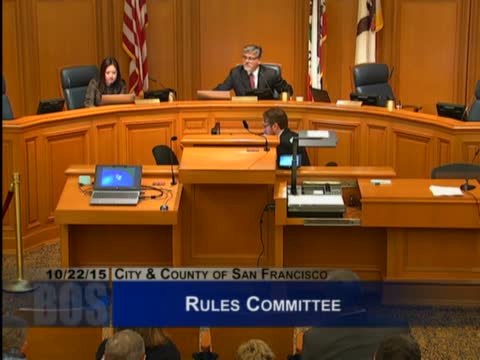
At an Oct. 22 Rules Committee hearing, San Francisco supervisors questioned SFERS staff about progress toward divesting from high-carbon fossil-fuel holdings. SFERS Director Jay Huish described a three-level engagement policy, recent proxy-policy changes and a board-approved $100 million passive fossil-free index investment being finalized this year.
San Francisco supervisors pressed the San Francisco Employees' Retirement System on Oct. 22 over the pace and scope of its response to climate-related investment risk, while retirement staff laid out a plan that includes stronger proxy voting, expanded engagement and a planned $100 million passive fossil-free index investment.
Chair Supervisor Avalos opened the hearing by noting the Board of Supervisors' April 2013 resolution urging SFERS to address stranded-asset risk posed by fossil-fuel companies and asked SFERS Director Jay Huish to outline the system's work since that resolution. Huish told the Rules Committee that SFERS now uses a three-step framework: level 1 active proxy voting; level 2 activism and shareholder engagement; and level 3 restrictions or divestment.
"We adopted level 1 engagement earlier this year and have amended our proxy policy to ensure we vote in favor of more disclosure on climate risk when those resolutions arise," Huish said. He acknowledged that earlier in the proxy season SFERS had missed opportunities to vote for climate-related shareholder proposals because the system's proxy provider did not supply advance notice. "We have since remedied that through membership in the Investor Network on Climate Risk and changes to our provider instructions," he added.
Huish described additional staff work to expand engagement: creation of an ESG committee on the retirement board, regional coordination with large public plans and investor coalitions, and staff-led meetings to explore alternatives to traditional fossil-fuel holdings. He told supervisors that in July the retirement board approved investing $100 million in a passive fossil-free index fund and that staff were in final contract negotiations, with the investment expected to be placed before year-end.
On scale and exposure, Huish described SFERS' total fund in the neighborhood of $20—621 billion and said fossil-fuel holdings had been about $565 million at one point and more recently around $480 million; market declines had cut that exposure further, he said, placing holdings below $500 million at the time of the hearing.
Supervisors and public speakers pressed for faster, clearer action. Supervisor Avalos and others questioned why some proxy votes had been missed and urged staff to present explicit timelines and analyses of the consequences of different approaches (for example, targeting the largest carbon reserve companies, following the Carbon Tracker 200, or pursuing a "worst-of-the-worst" list). Huish said staff would task portfolio staff to reconcile holdings with published lists and would return with impact analysis.
Bridal Fleischman of 350.org said INCR membership and access to research were useful but not a substitute for SFERS taking concrete public steps: "Joining a network is not the same as using it to trigger policy change," she said. Erin Gray of Green Century Capital Management told the committee that fossil-free portfolios can be consistent with fiduciary duty and cited recent underperformance of energy-sector indices as evidence that carbon-exposed holdings carry investment risk.
Public commenters, including retirees and fossil-fuel divestment advocates, urged rapid movement to level-3 restrictions, recommending partial divestment from coal and tar-sands producers and naming large corporate holdings such as Exxon, Imperial Oil and Royal Dutch Shell.
SFERS staff described institutional steps already taken: a July creation of an ESG committee, staff coordination with other public plans and an assignment to analyze worst-offender lists and the effects of potential divestment paths. On scheduling, Supervisor Cohen said he would ask the SFERS ESG committee chair to schedule a November meeting; the Rules Committee agreed to continue the call of the chair for follow-up reporting.
What happens next: SFERS staff said they would provide the requested holdings-by-list analysis and present implementation timelines to the ESG committee or full retirement board. The Rules Committee left the item open for a return check-in to review progress.