Get Full Government Meeting Transcripts, Videos, & Alerts Forever!
Get email alerts on the Budget Appropriation topic
No spam. Unsubscribe anytime.
Finance panel preserves ramp funds but advances reallocation to restore health services
Summary
After hours of testimony, the Board—s Finance Committee voted to reserve $760,163 earmarked for a City Hall wheelchair ramp while forwarding a revised ordinance to reappropriate $944,470 to restore midyear cuts to community behavioral health services, public health nursing, mental-health clinic directors and Buster—s Place (the drop-in center). The committee split on trade-offs between ADA access and urgent care services.
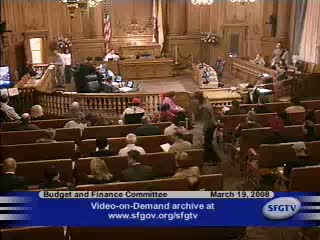
The San Francisco Board of Supervisors Finance Committee on March 19 voted to reserve $760,163 that had been budgeted for a wheelchair ramp at the Board—s dais and to send an amended supplemental appropriation to the full Board to restore $944,470 in midyear cuts to community behavioral-health services, public health nursing, and a downtown homeless drop-in center.
Supervisor Daly introduced the measure as an effort to protect services relied on by vulnerable San Franciscans. The proposal would move capital money previously set aside for accessibility work into recurring service funding for Buster—s Place, public health nursing and clinic directors for the fourth quarter of the current fiscal year. Ken Bruce of the Budget Analyst—s Office told the committee the uses total $944,470: $244,000 for Buster—s Place, $451,084 for public health nursing and $248,442 for mental-health clinic directors.
The mayor—s budget director, Nani Kolorey, and Human Services Agency Director Joyce Crum told the committee the administration had worked on a transition plan for Buster—s Place: the city proposes opening 150 Otis as a stopgap drop-in center with roughly 32 beds and daytime seating and shower capacity depending on fire-marshal approval. Dr. Mitch Katz, director of the Department of Public Health, said the department—s midyear reductions are intended to reduce next year—s cuts and described the proposed clinic-director consolidations as administrative changes intended to preserve clinical staff time.
Public comment filled more than an hour and a half. Disability-rights advocates, independent-living organizations and the mayor—s Office on Disability urged the committee not to pit access to the dais against social services. Several disability advocates argued that denying or delaying the ramp would create a civil-rights problem under the Americans with Disabilities Act. At the same time, clinic directors, public-health nurses and patients warned that eliminating the proposed service funding would reduce home visits, case management for chronically ill patients and culturally competent services at neighborhood mental-health clinics.
Committee members debated those trade-offs and whether the mayor—s office had adequately consulted the legislative branch before withholding appropriated funds. The dispute also turned on technical questions: the ramp project is in a landmarked chamber and requires a certificate of appropriateness for in-room construction, and the mayor—s office said some off-site work and design drawings were already under way to limit room closures.
Supervisor Ellsberg offered an amendment intended as a compromise: remove the proposed reappropriation of the general-fund reserve and other uses while keeping the $760,163 capital appropriation in place (a finance-committee reserve) so the ramp funds could be evaluated and alternatives developed. The roll call on that amendment was 3—0 (Ellsberg, Chu and Chair McGoldrick voted yes; Supervisors Mercurini and Daly voted no), so the amendment passed. The item as amended was forwarded to the Board with a 4—1 recommendation.
What happens next: the full Board will consider the amended ordinance. Committee members who opposed the amendment argued they wanted an immediate up-or-down vote to signal the board—s priorities for services; supporters said reserving the ramp funds gives staff time to develop lower-cost, ADA-compliant alternatives while protecting programs set to lose funding in weeks.
Authorities referenced: the action involved a supplemental appropriation and the certificate-of-appropriateness process for historic City Hall alterations; the legal requirement for a certificate to alter the landmark chamber was explained by the deputy city attorney.
Quotes that capture the dispute:
"When we have difficult budget times ... it's important that we look inside ourselves and ... attempt to do our best to mitigate harm ... to particularly vulnerable San Franciscans," Supervisor Daly said in support of restoring services.
"You cannot claim to represent people when you don't give them equal access," said a mayor's Office on Disability representative, summarizing disability-rights arguments in testimony.
Ending: The committee—s action preserved the existing capital appropriation for the ramp in committee reserve while authorizing the supplemental reappropriation as amended; the measure will be debated and voted by the full Board during its next available session.