Get Full Government Meeting Transcripts, Videos, & Alerts Forever!
Get email alerts on the Surplus Property topic
No spam. Unsubscribe anytime.
Supervisors Hear Proposal to Prioritize Affordable Housing on City Land; Support Strong at Rules Committee
Summary
Supervisors and dozens of public commenters backed a ballot initiative by Supervisor Jane Kim to expand the surplus property ordinance, require annual public reporting of underused sites, give the mayor's housing office 120 days to evaluate acquisitions, and set minimum affordability requirements; city staff voiced concerns about flexibility for mixed‑income projects and funding constraints.
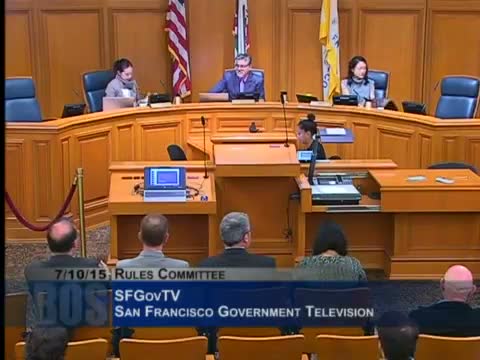
Supervisor Jane Kim on Friday presented a proposed ballot initiative that would amend San Francisco's surplus property ordinance to prioritize affordable and middle‑income housing on city‑owned and other public sites. The measure would require local agencies to report underutilized properties of a quarter acre or larger, give the Mayor's Office of Housing and Community Development (MOHCD) a 120‑day period to evaluate and negotiate for sites, and set a 50 percent minimum affordability requirement if a site is later disposed for private development.
The proposal, introduced with four signatures so it can appear on the November ballot unamended, seeks to align local rules with the state surplus lands law recently updated by Assemblymember Phil Ting (AB 2135) and to further the goals of Proposition K, which sets citywide targets for affordable and middle‑income housing. April Veneracion of Supervisor Kim's office outlined the measure's calendar: agencies report by Jan. 1; the city administrator compiles a report by Feb. 1; the Board holds a hearing by March 1; and MOHCD evaluates feasibility by March 15, after which sites deemed suitable may be transferred to the mayor's office for affordable housing development.
City staff said the proposal complements the Mayor's Office's Public Lands for Housing efforts but raised caveats. Mike Martin of the Office of Economic and Workforce Development said the city has limited subsidy resources (MOHCD funding is largely programmed through 2020 to meet Prop K low‑income targets) and that the initiative's limit of a mixed‑income option to sites larger than two acres could exclude many infill or tall, narrow sites that nonetheless could support workforce housing. John Updike, Director of Real Estate, said the annual inventory process has moved online and asserted that reporting has occurred, but he acknowledged enforcement and resource gaps for identifying and following up on surplus sites; a dedicated surplus property staff position was recently approved in the budget.
Public commenters from housing advocates, nonprofit developers and tenant groups offered strong support. Fernando Marti (Council of Community Housing Organizations), James Tracy (Community Housing Partnership), Dean Preston (Tenants Together), Chelsea Boylard (Coleman Advocates), Whitney Jones (Chinatown Community Development Center) and many others urged the Board to place the measure on the ballot, saying public land is a scarce resource that should be used to meet housing needs for homeless families, low‑income households and middle‑income workers. Several speakers cited AB 2135 and the need for greater transparency and regular public review of surplus sites; one commenter noted the city recently paid $18.5 million for a privately owned site that will yield 72 units, arguing that building on public land would use housing dollars more efficiently.
Supervisors thanked speakers and signaled interest in refining the language on implementation. Supervisor Katie Tang said she wants to ensure the measure leads to more properties being declared surplus or underutilized; Kim said the initiative expands the definition beyond strictly "surplus" sites to include underutilized and opportunity sites and adds public hearings so the Board and public can scrutinize the inventory. There are two parallel tracks: an initiative with four signatures (which cannot be amended by the Board) and an alternate version that could be amended and carry additional cosponsors. Session minutes show two procedural motions taken without recorded objection: a motion to excuse Supervisor Malia Cohen earlier in the meeting, and a motion to file the hearing. The committee adjourned after the filing motion.
The measure advances the broader effort to use city land to increase affordable and workforce housing, but staff cautioned it could constrain flexibility for some mixed‑income financing approaches and stressed that MOHCD subsidy capacity and project‑level feasibility will remain central to whether sites can be developed as intended. The Board is expected to continue the dialogue at upcoming Rules Committee sessions and on the July 21 Board of Supervisors agenda.