Get Full Government Meeting Transcripts, Videos, & Alerts Forever!
Get email alerts on the Homelessness Shelters topic
No spam. Unsubscribe anytime.
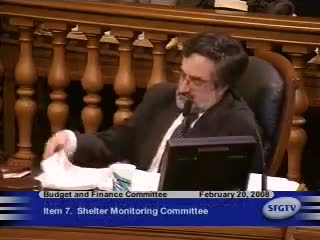
After hours of testimony, supervisors continue shelter standards ordinance to refine costs and amendments
Summary
Supervisor Tom Ammiano's ordinance to require minimum standards of care in city-funded shelters and to staff the shelter monitoring committee drew extensive public support and testimony; the committee passed amendments and continued the matter two weeks to refine language and address fiscal concerns, including ADA spacing and potential bed loss.
Supervisor Tom Ammiano introduced companion ordinances to require minimum standards of care in city-funded shelters and to staff the Shelter Monitoring Committee with three full-time employees. He described the proposals as public-health and human-rights measures that would require basic supplies, ADA compliance, staff training, minimum spacing and contractual remedies for noncompliance.
The City Attorney summarized amendments that add contract provisions (training, accessible sleeping units, 7-night reservations for single-adult shelters unless inconsistent with Proposition N, Cal/OSHA compliance, language on charging electricity for cell phones/medical equipment, and multilingual communications). Budget analyst Deborah Newman outlined a fiscal impact range of $1.8 million to $2.3 million annually, but also noted reductions (about $470,000) where provisions would not require added expense, and the potential that costs could be lowered through implementation choices.
Department and mayoral representatives asked for additional time to analyze costs and implementation; the PUC/HSA asked for continued engagement to avoid making difficult budget decisions in a vacuum. The Shelter Monitoring Committee chair and dozens of public commenters — including shelter residents, providers, advocates and health workers — urged swift passage to address documented shortages of basic supplies, hygiene and safety. Public health testimony emphasized infection control, hygiene and disaster-readiness.
Given the volume of testimony and outstanding technical and fiscal questions (including smoking-waiver provisions and ADA spacing that had earlier been revised to avoid bed loss), the committee voted to continue the ordinance to the call of the chair (March 4 was suggested) so sponsors and city departments could finalize amendments and seek broad support to avoid a mayoral veto.