Get Full Government Meeting Transcripts, Videos, & Alerts Forever!
Get email alerts on the Campaign Finance topic
No spam. Unsubscribe anytime.
Rules Committee forwards campaign finance overhaul to full Board; keeps duplicate file for limited follow-up
Summary
The Rules Committee forwarded an ordinance to simplify and consolidate San Francisco's campaign finance rules to the full Board with a recommendation, while keeping a duplicate file in committee to refer a vendor‑disclosure amendment back to the Ethics Commission. Key changes include removing unenforceable contribution limits, 24‑hour disclosure for $1,000+ outside spending within 90 days of an election, and standardized disclaimers.
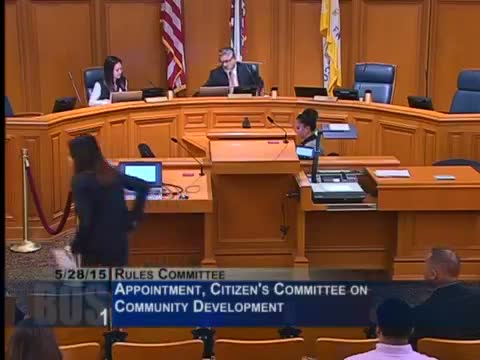
The Rules Committee on May 28, 2015 voted to forward to the full Board an ordinance proposed by Board President London Breed’s office and the Ethics Commission to update San Francisco’s Campaign Finance Reform Ordinance (CFRO).
Connor Johnston, legislative aide to Board President London Breed, described three chief aims: eliminate local contribution limits that courts have rendered unenforceable, consolidate multiple local reporting triggers into a single state‑aligned 90‑day/24‑hour reporting standard for third‑party spending, and standardize paid‑for‑by disclaimers to improve legibility and compliance. "You should not need a legal team to file campaign reports nor a law degree to understand them," Johnston said.
Jesse Menardi, deputy director of the Ethics Commission, provided the technical detail. The ordinance would remove an aggregate contribution limit that the commission has suspended enforcement of after McCutcheon v. FEC and remove an earlier $500 limit for certain independent committees that had been enjoined; it would require disclosure within 24 hours of $1,000 or more in outside spending during the 90 days before an election; and it would require readable disclaimer fonts and direct readers to donor information on the Ethics Commission website. Menardi told the committee the Ethics Commission passed the package unanimously in January and February.
Supporters in the public comment period — including professional campaign treasurers and small‑campaign advocates — said simplification and online posting of reports will improve transparency and compliance for grassroots groups. Larry Bush of Friends of Ethics urged more time, asking the committee to put the item over so the group’s suggested changes could be considered; he specifically pressed concerns about a proposed nonprofit exemption and the deletion of vendor‑payment disclosures.
Supervisors debated several amendments: Chair Avalos proposed removing a narrow exemption for some 501(c)(3) fundraising invitations (to avoid possible electioneering gaps) and restoring vendor‑payment disclosure language; others raised implementation concerns and the need to avoid duplicative or redundant local rules where state law already applies. The committee adopted a procedural compromise: it forwarded the main ordinance to the full Board with recommendation in time for the 2015 election cycle, and it kept a duplicate file in committee to return certain vendor‑disclosure language to the Ethics Commission for follow‑up.
Deputy City Attorney John Gibner said the ordinance would take effect 30 days after the mayor signs it; Jesse Minardi (Ethics Commission) said staff aims to have the necessary forms and online posting ready by late June so mid‑year and subsequent filings would follow the new standards in time for the November 2015 election.
Next step: the Board of Supervisors will consider the ordinance at its June meeting; a duplicate committee file will be referred back to the Ethics Commission for a limited amendment review.