Get Full Government Meeting Transcripts, Videos, & Alerts Forever!
Get email alerts on the Voting Systems topic
No spam. Unsubscribe anytime.
Committee debates Sequoia voting contract after hours of public testimony, forwards measure to full Board
Summary
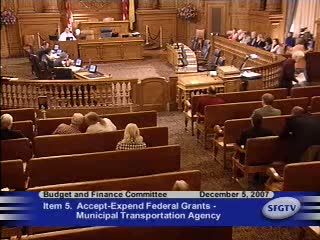
The Budget & Finance Committee considered a proposed four-year contract with Sequoia Voting Systems on Dec. 5, 2007, amid sustained public concern about security and certification for ranked-choice voting; the committee voted to forward the contract to the full Board without a committee recommendation.
The Budget and Finance Committee of the San Francisco Board of Supervisors spent the bulk of its Dec. 5, 2007 meeting on a proposed four-year contract with Sequoia Voting Systems for new voting equipment and associated services. The clerk read the item as a roughly $12,660,000 contract; department and budget staff described contractual changes, new requirements for a full demonstration by Feb. 12 and a $650,000 withholding tied to that demonstration.
Why it matters: The contract would supply paper-based, machine-tallied systems used to count ballots citywide, and speakers — including technologists, election officials and advocacy groups — clashed over whether the proposed safeguards are sufficient for ranked-choice voting (RCV) and election security.
Mr. Arndt, representing the Department of Elections, said the amended contract removes certain voter-verified paper-audit-trail items and some battery backup packs and adjusts software-maintenance fees; he described about $750,000 in net changes from earlier pricing miscalculations and said the contract includes a requirement for Sequoia to furnish source code to a third-party reviewer and to respond to draft reports before a final review is issued. He also said Sequoia would follow any future state rules governing disclosure and that the company would be required to adapt if another certified, disclosed-source vendor appeared during the contract term.
Budget analyst Deborah Newman told the committee the clerk-read figure for the contract is about $12.66 million but that, with roughly $5.5 million in federal and state grants, the city’s general fund obligation would be about $7.1 million over four years. Newman added that the contract includes funds for capital improvements to a warehouse (likely Pier 48) and that a lease for that space would add an estimated $750,000 a year, raising the general-fund exposure to roughly $9.2 million over four years. She also warned the committee the city would pay for the third-party review but that the cost and funding source were not yet estimated.
The committee heard extensive public comment. Technical and civic advocates urged the Board to pursue open-source solutions and, in the short term, to require rigorous independent review and demonstration. "Open source ballots for RCV" was a repeated theme from Supervisor Tom Ammiano, who said posting anonymous ballot images online would allow independent parties to re-run tabulations and add redundancy to the verification chain. Mr. Ammiano urged creation of a public-interest voting-equipment task force to study long-term open-source options and the possibility of the city acting as its own vendor.
Opponents argued Sequoia systems have documented vulnerabilities and, in some jurisdictions, have been decertified. A Tehama County elections employee testified that Sequoia equipment had failed in prior elections and described an incident in which results were transmitted via the internet and external assistance was required to produce a printout. Speakers urged hand counts, spot-checks or delaying purchase until an open-source alternative is certified. Supporters — including Rich Matthews, who said the Elections Commission unanimously recommended approval — argued the proposed system is paper-based and can be reconciled with manual rechecks and signaled willingness to increase manual tally percentages if needed.
After deliberation, Chair Aaron Peskin said the committee would forward the contract to the full Board "without recommendation," noting the contract contains termination and buy-back provisions and that the committee expects continued oversight and interim measures (including manual tally percentages). Supervisors Ammiano and Duffy expressed support for forwarding the item while pressing staff to pursue transparency measures and a task force to pursue open-source development.
What comes next: The committee sent the item to the full Board for final consideration at the next Board meeting; the committee record and public testimony will travel with the item. The department must complete the promised demonstration by Feb. 12 or face the contractual withholding specified in the amendment.
Representative quotes
"What I'd like to push for, open source ballots for RCV...the ballot images...will be put on the web so they can be downloaded by anyone, and that person can run the RCV tabulation for her or himself," Supervisor Tom Ammiano said in committee remarks advocating added transparency.
"These problems have been in Sequoia for a number of years, and Sequoia has been very reluctant to address the problems," said Scott Loopking, a human–computer interaction specialist who evaluated equipment in Sacramento.
"The proposed contract with Sequoia is about $12,500,000. In addition to about $5,500,000 of federal and state grant funds, the city's general fund will be obligated to spend about $7,100,000 over the next four years," Deborah Newman, Budget Analyst, said to summarize fiscal exposure.
Notes on reporting and scope: The article attributes claims and technical allegations to the speakers who made them in committee and in public comment. Where speakers gave differing numbers or characterizations (for example the clerk-read contract amount and later rounded figures by staff), this article reports both the clerk-read figure ($12,660,000) and the budget analyst's rounding and downstream obligations to reflect the record. Allegations about decertification and failure in other jurisdictions are presented as testimony from public speakers and are not substantiated here beyond the hearing record.
Provenance: Topic begins with the clerk reading Item 2 and Mr. Arndt's presentation and continues through the committee referral (transcript segments from SEG 064 to SEG 1144).