Get Full Government Meeting Transcripts, Videos, & Alerts Forever!
Get email alerts on the Language Access topic
No spam. Unsubscribe anytime.
Rules Committee advances overhaul of Language Access Ordinance after budget analyst's report
Summary
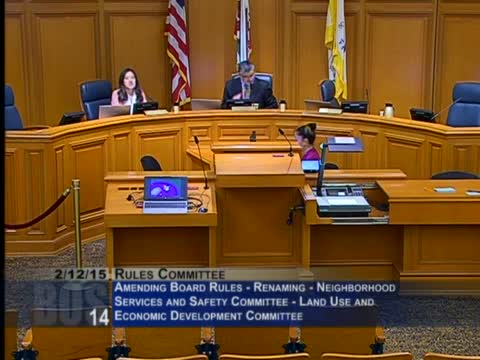
Supervisors voted Feb. 12 to forward amendments to the Language Access Ordinance that eliminate a tiered department system, centralize complaints at OSEA, and encourage translated signage and vendor consolidation after a Budget Analyst report estimating roughly $7.6 million in city language-access expenditures for FY2013-14.
Supervisor Katie Tang presented a package of amendments to the city's Language Access Ordinance (LAO) aimed at expanding and standardizing language services across municipal departments. Tang said the changes remove the ordinance's prior tiered system so that all departments providing services directly to the public must ensure language access; they also centralize the complaint process at the Office of Civic Engagement and Immigrant Affairs (OSEA), streamline annual compliance reporting, encourage translation of public signage and websites, and require OSEA to maintain a certified vendor pool for translation and interpretation services.
Severn Campbell and colleagues from the Budget and Legislative Analyst's office presented a citywide survey of language-access expenditures and practices. Their report found city departments self-reported about $7.6 million in language access expenditures in fiscal year 2013-14 across bilingual premium pay, telephonic interpretation, vendor contracts for on-site and document translation, and other services. The BLA recommended consolidating vendor contracts into a master contract to standardize rates and quality, improving coding for language-service expenditures in the city purchasing system, and encouraging more aggressive bilingual certification for city employees so that resources and needs are better tracked.
OSEA's Adrian Pon described the office's role coordinating implementation of the LAO since the 2009 amendments, noting that a small in-house team of interpreters and translators supports departments and that community partnerships (the Language Access Network and other nonprofits) supplement city efforts. BLA staff also reported that departments use a mix of certified bilingual employees, third-party vendors and telephonic services and that contract rates and quality vary widely.
Community commenters including representatives of the Language Access Network, Chinese for Affirmative Action, veterans'housing advocates and others urged the Board to adopt the amendments and to prioritize implementation details such as translating housing application materials, improving access to Mayor's Office of Housing programs, and funding OSEA to handle increased workload. Tang said some departments would be given until the next fiscal year to meet new interpretation and translation timelines to allow budget planning, and she offered amendments to refine compliance timelines and reporting.
After discussion and proposed clean-up amendments, the committee voted to forward the LAO amendments to the full Board with a positive recommendation. The committee also accepted recommendations from the Budget and Legislative Analyst office and directed staff to continue work during the budget season on implementation and potential consolidation of contracts and services.