Get Full Government Meeting Transcripts, Videos, & Alerts Forever!
Get email alerts on the Transbay Cable topic
No spam. Unsubscribe anytime.
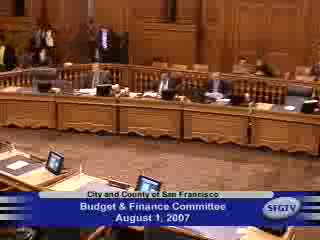
Budget panel backs Transbay Cable, adopts Maxwell amendments and forwards items to full Board
Summary
The San Francisco Board of Supervisors Budget & Finance Committee voted to forward three Transbay Cable items—CEQA concurrence, two Port license resolutions and a revocable right-of-way permit—to the full Board after adopting four amendments by Supervisor Sophie Maxwell that shorten license terms, require further local transmission studies and specify how public-benefit funds are used.
The San Francisco Board of Supervisors Budget & Finance Committee on Aug. 1 voted to send three Transbay Cable items to the full Board as amended, after adopting a package of amendments by Supervisor Sophie Maxwell that reduce term lengths and add study and community-benefit requirements.
The committee considered resolutions to adopt CEQA findings and to approve two Port Commission licenses for submerged land and onshore uses to support a roughly 400-megawatt, direct-current transmission line that would run about 9.4 miles across the bay and land near 20 Third Street. Port special project manager Brad Benson summarized the negotiated construction license (up to four years) and an operation license with an initial 25-year term plus options, and described proposed annual rent and public-benefit payments to the port and the San Francisco Public Utilities Commission (SFPUC).
"Once the operation period license starts, annual rent payments to the port [are] about $1,300,000 increasing by 2% per year," Benson said, and described an SFPUC package the staff characterized as roughly $2 million a year indexed over a 10-year period and other public-benefit elements.
Joan Lamphere, who manages the environmental review for the city of Pittsburgh (lead agency on the project'wide CEQA documents), told the committee that the environmental record identified several "potentially significant impacts," but that mitigation measures in the project record would reduce those impacts "to a level of less than significant." Lamphere said those mitigation measures include standard construction controls, a cleanup plan reviewed by the Regional Water Quality Control Board, traffic timing to avoid peak hours and noise mitigation at the converter station.
SFPUC staff also presented. Assistant general manager Barbara Hale said the PUC's analysis concluded the Transbay Cable "on balance, may result in overall benefits to San Francisco, since it would increase electrical reliability and could result in significantly reducing our reliance on in-city generation." Hale and other PUC staff urged continued parallel work on energy efficiency, demand-response measures and interconnection work for the city's 230 kV and 115 kV systems.
Supervisor Sophie Maxwell introduced four substantive amendments. They shortened the maximum Port license exposure from a multi-decade maximum to an initial 25-year term with a 10-year option, committed the city to study two additional in-city transmission projects (the Petro Embarcadero project and a Newark'San Francisco line) to strengthen local reliability, secured commitments from the project sponsor that could include the city purchasing up to 25 megawatts of wind power on reasonable terms and laid out a public-benefit distribution that would allocate funds for renewable-energy, conservation and workforce development programs, with a specific $2 million allocation for green job development.
Budget analyst Mr. Rose presented preliminary fiscal estimates for the city. His office reported an estimated $75.8 million of revenue to the city from the combined package (port and SFPUC receipts) and offered an initial calculation that Supervisor Maxwell's amendments could reduce license-fee revenue by roughly $8.2 million, producing an adjusted estimate of about $67.6 million. Rose also cited Transbay'provided estimates of $875,000—10,000 annually in new property taxes, of which roughly $570,000—650,000 would accrue to the city's general fund, but noted the assessor lacked definitive possessory-interest calculations in the record.
During public comment, renewable-energy and transmission advocates urged the committee to approve the project to expand the state's transmission capacity and meet renewable portfolio goals. Representatives of labor and the building trades said the project included local-hire and wage commitments for construction and would create regional jobs. Residents of Bayview'Hunters Point and community groups expressed concern about siting, construction impacts and the distribution of public-benefit funds; multiple speakers urged that community-benefit dollars be directed to District 10 and flagged past outreach gaps.
David Parquet, representing the project sponsor (Babcock & Brown), confirmed the sponsor had reviewed Supervisor Maxwell's amendments and said the company was in accord. After technical cleanup language proposed by counsel and port staff, the committee accepted the Maxwell amendments (moved in the meeting by Supervisor Tom Ammiano) without objection and, "as three times amended," forwarded the items to the full Board with a favorable recommendation.
What happens next: The committee referred items 1—3 (CEQA concurrence; Port licenses for submerged and onshore rights; and the revocable right-of-way permit for underground cable) to the full Board of Supervisors with the committee's recommendation that the Board adopt the CEQA findings and approve the license agreements as amended. The items will return to the Board for final action and any additional CEQA or permitting steps required by state or local law.
Sources: Committee presentations by the Port and SFPUC, the Budget Analyst's executive summary and public comments recorded at the Aug. 1 committee meeting.