Get Full Government Meeting Transcripts, Videos, & Alerts Forever!
Get email alerts on the Minimum Wage topic
No spam. Unsubscribe anytime.
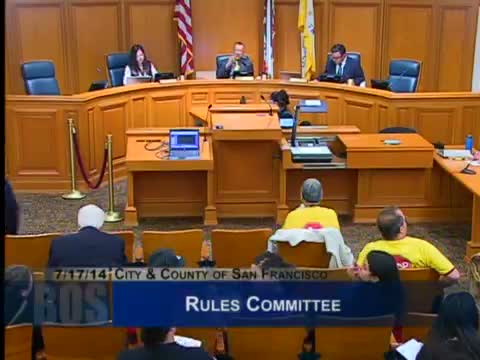
San Francisco rules committee advances $15 minimum-wage ballot measure with enforcement amendments
Summary
The Rules Committee advanced a November ballot measure that would raise San Francisco—s minimum wage to $15 by 2018 and added enforcement amendments, while the city—s comptroller warned of modeled job impacts and the business community urged longer phase-ins for small employers.
The San Francisco Board of Supervisors— Rules Committee on July 17 advanced a ballot ordinance that would raise the city—s minimum wage to $12.25 on May 1, 2015 and phase it to $15 an hour by July 1, 2018, adopting a set of enforcement amendments authored by Supervisor Jane Kim and agreeing to continue the item to the committee—s July 24 meeting to finalize language.
Supervisor Jane Kim, sponsor of the measure, told the committee the proposal contains no tip credit or health-care credit and would apply citywide, including two categories of government-supported employees. Kim read three amendments into the record that add an "enforcement priority" policy directing the mayor and the board to study tools to combat wage theft; require city departments to cooperate with revocation or suspension requests from the Office of Labor Standards Enforcement; and change the operative date to May 1, 2015 so the measure preserves a consumer-price-index increase already scheduled under existing law.
"San Francisco is yet again setting the bar for workers' rights," Kim said, and she emphasized coalition support from labor, nonprofits and business groups for a unified ballot measure. Tamsen Drew, speaking on behalf of the mayor's office, said Mayor Ed Lee—s team had participated in the drafting process and supported Kim—s amendments.
The committee also heard the city—s economic analysis from Ted Egan of the Controller's Office. Egan—s presentation reiterated the ordinance timeline and estimated that roughly 60,000 workers in San Francisco may now earn the minimum wage (about 11 percent of the local workforce), concentrated in food service, retail trade, manufacturing, personal services and social assistance. Egan said the increase would raise earnings and local spending but also lift labor costs, and his modelling projected the city could have "about 15,000 fewer jobs by 2019" compared with a no-increase scenario — an employment effect he characterized as about 2 percent of private employment and concentrated in food service and retail.
"There will be an employment impact associated with raising the minimum wage," Egan said, and urged that the city consider flexibility to respond in the event of an economic downturn.
Supporters, including labor leaders and nonprofit representatives, disputed the size of the employment estimate and pointed to other studies forecasting larger beneficiary counts. "We have all seen that San Francisco has had a huge economic increase in the tech industry," said a Progressive Workers Alliance speaker, "but what matters is how we address the needs of our most vulnerable workers." Several public commenters described housing and rent pressures and said a higher wage is essential to keep working San Franciscans in the city.
Business representatives and the Golden Gate Restaurant Association welcomed the goal but asked for a longer ramp-up and small-business carve-outs. Samantha Higgins, representing restaurants, asked the board to consider a longer phase-in and alternatives such as different schedules for firms with fewer than 100 full-time equivalent employees.
After public comment, the committee moved to introduce Supervisor Kim—s amendments and passed that motion without objection. The committee then voted to continue the ordinance, as amended, to the July 24 Rules Committee meeting for further consideration and final committee action.
What happens next: the item was continued to July 24 so committee members and staff can finalize amendment text. The Rules Committee action will determine whether the measure is forwarded to the full Board of Supervisors for placement on the November ballot.
Sources: Presentations and testimony at the July 17 Rules Committee meeting (Supervisor Jane Kim; Tamsen Drew, Mayor's Office; Ted Egan, Office of the Comptroller) and public commenters representing labor, nonprofits and the restaurant industry.