Get Full Government Meeting Transcripts, Videos, & Alerts Forever!
Get email alerts on the Shelter Monitoring topic
No spam. Unsubscribe anytime.
Rules Committee hears Shelter Monitoring Committee reports on complaints, language access and transportation
Summary
The Shelter Monitoring Committee presented its 2012–13 Standard of Care annual report and first/second quarter updates, reporting 128 client complaints (64 committee‑issued), language‑access and signage gaps, LGBT/trans safety work, training shortfalls, a new shelter shuttle and limited token funding (about $29,000 annually, ~1,200 tokens/month).
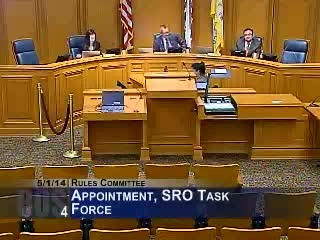
SAN FRANCISCO — The Rules Committee on May 1 received quarterly reports from the Shelter Monitoring Committee and staff from the Department of Public Health and the Human Services Agency (HSA) outlining complaint trends, language‑access gaps, LGBT/transgender safety measures, staff training and transportation supports for shelter clients.
Bernice Casey, presenting the Shelter Monitoring Committee’s annual Standard of Care report and two quarterly updates, said the committee recorded 128 client complaints in the fiscal year and issued 64 complaints after site inspections; she told the committee all committee‑issued complaints were closed because sites had responded. Casey also said the committee found that about 72% of complainants lacked contact information (no phone, email or mailing address), which has complicated follow‑up, so the committee now conducts site inspections to verify issues when complainants cannot be reached.
Casey described recurring complaint categories — facilities, access and staff conduct — and highlighted that some providers (including St. Joseph’s, United Council and Compass) had no client complaints during the reporting year, while other sites had higher counts listed in the appendix. She said the committee is pushing for clearer reporting on shared facilities, better signage and greater use of bilingual staff and language‑link services. "One of the areas the Human Services Agency has brought up to us is, how this area, the no contact area, isn't really the way the committee is presenting it...so what happens is when a client files a complaint, the site responds and then the client...has the opportunity to read the response and decide whether they agree or don't agree," Casey said.
Scott Walton, HSA’s Housing and Homeless Division representative, described improved coordination between the Shelter Monitoring Committee, the Department of Public Health and HSA, and outlined HSA efforts on training and transportation. Walton said HSA budgets about $29,000 annually for tokens — roughly 1,200 tokens per month — and confirmed the agency pays $2 per token. He also described a shelter shuttle launched July 1, 2013 that offers scheduled one‑way routes from outlying shelters into Central City and back; Walton said the shuttle transported more than 1,400 riders in March.
Walton acknowledged training challenges at large 24‑hour sites and smaller providers, and noted HSA and DPH provide several training avenues. He told the committee HSA trained 75 shelter staff on access for persons with disabilities that morning and planned additional sessions before the end of the fiscal year.
Supervisors pressed HSA and the committee on practical impacts: whether lack of tokens prevents clients from attending medical appointments, training or job interviews, and whether pilot oversupply of tokens could measure demand. Chair Norman Yee suggested a short pilot to temporarily increase token availability under the same rules so HSA and contractors could measure true demand; Walton said he would consult contractors on implementation and costing.
The committee continued the item to the call of the chair for further follow‑up.
Key figures and next steps: 128 client complaints reported for the fiscal year; 64 committee‑issued complaints (all closed); roughly 72% of complainants lacked contact information; HSA token budget ~$29,000/year (~1,200 tokens/month at $2/token); shelter shuttle launched July 1, 2013 and carried 1,400+ riders in March. HSA and the Shelter Monitoring Committee will return with more specific usage and pilot plans.