Get Full Government Meeting Transcripts, Videos, & Alerts Forever!
Get email alerts on the Wifi Agreement topic
No spam. Unsubscribe anytime.
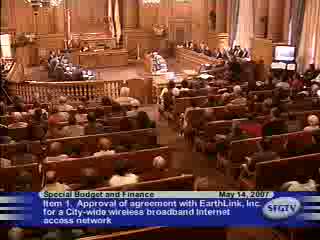
Supervisors Continue Review of EarthLink–Google Citywide Wi‑Fi After Technical, legal and privacy concerns
Summary
The Budget & Finance Committee heard multi‑hour testimony on an EarthLink/Google citywide Wi‑Fi franchise: DTIS and controller analyses outlined costs and consumer savings while the ACLU and residents pressed for stronger privacy, coverage and backup‑service protections; the committee continued the item for further review.
Chair Chris Daly convened the San Francisco Board of Supervisors Budget & Finance Committee on a proposed agreement that would let EarthLink (with partner Google) install and operate a citywide wireless broadband network in city right‑of‑way, provide a free basic service tier and a paid premium tier, and direct a share of revenues to a digital inclusion fund.
The proposal, presented by the Department of Telecommunications and Information Services, would require no direct city capital outlay, include a $600,000 non‑refundable prepayment to the city and a 5 percent gross‑revenue share. DTIS staff described a two‑square‑mile proof‑of‑concept pilot before any broader rollout, a four‑year initial term with options to renew, and a free basic tier that the city and controller characterized as roughly 300 kilobits per second with an optional premium tier near 1 megabit per second for paid subscribers.
Why it matters: the controller’s office forecasted consumer savings from competition and the new service in a broad range — roughly $9.6 million to $18 million annually under the staff assumptions — but both the controller and budget analyst warned that universal access alone will not close the digital divide without devices, training and multilingual content. Committee members and residents emphasized that coverage, indoor penetration and privacy protections are critical to whether the program will reach the intended communities.
Technical and legal tradeoffs: Supervisors questioned DTIS and EarthLink about the free‑service baseline speed, indoor coverage limits for buildings taller than about 40 feet, and topography‑related dead‑spots. DTIS said EarthLink estimated 95–98 percent coverage for areas beneath the 40‑foot threshold, and the proof‑of‑concept would confirm quality before any citywide rollout. The contract amendment accepted in committee gives EarthLink the contractual right to suspend deployment if a legal challenge is pending for 45 days and to terminate the agreement if litigation remains unresolved after 24 months; the city attorney described those as negotiated commercial protections in the event of lengthy court actions.
Privacy and public‑interest concerns: Nicole Ozer, technology and civil‑liberties policy director at the ACLU of Northern California, urged the supervisors to insist on contractual limits to tracking, retention and cross‑use of user data, saying the current draft "gives many added benefits to EarthLink and Google, but imposes many hidden costs on San Franciscans by allowing the companies to track who we are, what we're looking at online, and where we're looking at it from." DTIS and other supporters said privacy issues can be addressed through specific contract amendments and operational safeguards.
Public testimony: Dozens of community leaders, educators and residents urged approval, saying free Internet access would help students, seniors and jobseekers in underserved neighborhoods such as District 10. Other speakers — including disability advocates and community technologists — asked for guaranteed indoor coverage, equipment subsidies and training programs to ensure the service is usable by those with limited means.
What’s next: After extended debate and a request to review the ACLU recommendations and technical coverage data, the committee continued consideration of the Wi‑Fi agreement to a future date certain so staff can return with additional analyses and the pending pole‑use agreement. The committee’s agenda noted continued discussions about pursuing a municipal broadband alternative in parallel.
The committee recessed and later returned to schedule follow‑up work; no final approval of the EarthLink agreement was taken at the meeting.