Get Full Government Meeting Transcripts, Videos, & Alerts Forever!
Get email alerts on the Housing Hiv Aids topic
No spam. Unsubscribe anytime.
San Francisco supervisors hear report urging $3.8M backfill, 500 new subsidies and housing reforms for people with HIV/AIDS
Summary
The Board of Supervisors Budget & Finance Committee heard Department of Public Health recommendations to use general-fund dollars to prevent loss of housing for nearly 500 people with HIV/AIDS, add 500 tenant-based subsidies and 55 supportive units, and reform the housing wait list amid anticipated federal CARE Act cuts.
The San Francisco Board of Supervisors Budget & Finance Committee on a special hearing considered recommendations from a Department of Public Health (DPH) convened HIV/AIDS housing work group aimed at preventing housing loss for people living with HIV and AIDS as federal funding shifts.
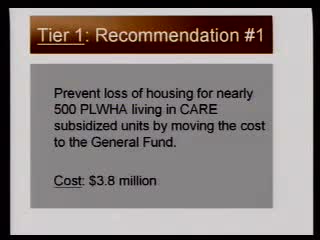
DPH presenter Mark Trotz told the committee the work group’s top priority is “to prevent the loss of housing for nearly 500 people living with HIV and AIDS, in care-subsidized units” and said that would require “$3,800,000 worth of funding that we really need to find to keep 500 existing people in their housing.” The report, developed by a 24-member group, breaks recommendations into tiers: immediate steps to backfill funding and stabilize housing, mid-term steps to improve access, and longer-term ideas including a community land trust and employment supports.
Why it matters: Trotz and multiple community witnesses said federal changes to the Ryan White/CARE Act and the Health Resources and Services Administration (HRSA) guidance are reducing the city’s ability to use CARE funds for housing. DPH officials told the committee they have been spending “upwards of 50%” of CARE dollars on housing and that the CARE reauthorization’s 75% core-service rule would further constrain housing uses.
Key recommendations and costs: The work group recommends (1) moving the cost of existing CARE-funded housing for roughly 500 people to the general fund ($3.8 million); (2) adding 500 tenant-based subsidies for the private market (recommended split: 300 shallow, 200 deep); and (3) securing about 55 additional supportive-housing units tied to the existing affordable-housing pipeline (estimated at roughly $1 million). Other recommendations include funding expanded eviction-prevention services (legal aid, one-time back rent and short-term rent subsidies), streamlining the HIV/AIDS housing wait list, allowing more flexible placements into RCFCIs (residential care facilities for the chronically ill), and pursuing a pilot community land trust and about 100 supportive employment positions.
Local and budget context: DPH presented inventory figures, including roughly “under 600” deep subsidies, a little over 400 shallow subsidies, about 425 project-based slots, and approximately 113 RCFCI beds. The presentation cited an estimate of about 18,300 people living with HIV/AIDS in San Francisco and local estimates that hundreds to thousands are homeless or at risk of homelessness. DPH summarized plan costs in slides as about $8.9 million for lost/backfill and new subsidies and the presenter cited a rounded total of "about 9.5" million across tiers; DPH staff said most of the large-ticket items would be ongoing costs.
Administration response: Nani Coloretti, the mayor’s budget director, told the committee the mayor sees housing for people with AIDS as a critical priority and said the city is lobbying in Washington to protect Ryan White funding. She warned of a likely federal shortfall and said the administration would attempt to cover as much as possible in the mayor’s budget but did not give final numbers.
Public comment: Twenty-six speakers took the podium. Redevelopment Agency staff, service providers and client-advocates uniformly urged the Board to adopt the recommendations and to use city funds to backfill federal losses. Speakers described living in substandard SROs, successes at residential care sites (Leland House, My Tree), and the public-health benefits of stable housing. Multiple providers noted that housing is both a health intervention and a prevention tool and asked supervisors to include the recommendations in the budget.
Next steps: The committee did not vote on the recommendations. Chair Daley and Supervisor Dufty thanked participants and said the committee will continue the item under the call of the chair after the mayor’s budget is published, with a plan to return for follow-up during the budget process (the chair suggested a possible August/September return).