Get Full Government Meeting Transcripts, Videos, & Alerts Forever!
Get email alerts on the City Budget topic
No spam. Unsubscribe anytime.
Three‑year projection shows modest first‑year shortfall but improved outlook for San Francisco general fund
Summary
Controller’s joint report projects a $25 million shortfall in the first year (FY 2007–08), a larger shortfall the following year, and a return to surplus in year three; the report credits revenue growth and one‑time fund balance while warning of volatility in property transfer tax.
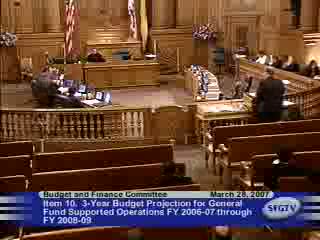
The San Francisco Board of Supervisors Budget & Finance Committee on April 1 received a joint three‑year budget projection that forecasts a $25,000,000 shortfall in the first projected year but a turnaround to a small surplus in the third year.
Todd Reekstrom of the Controller’s Office told the committee the first‑year shortfall represents “a little less than 1%” of the roughly $3.3 billion in general‑fund‑supported spending and is substantially smaller than the multi‑hundred‑million shortfalls the city faced during the recession. He said the report projects an $85,000,000 shortfall in year two and an approximately $8,000,000 surplus in year three.
Reekstrom said the projection follows a charter‑required methodology that assumes the use of all available sources and uses, including fund‑balance appropriations, making the near‑term position sensitive to how much one‑time fund balance the budget uses. He said the city is on track to deposit an additional $21,000,000 into the voter‑approved rainy‑day reserve, bringing the projected balance to about $119,000,000 by year end.
Ken Bruce, the budget analyst, cautioned the committee that a sizable share of recent revenue gains come from a small number of large commercial property transfers and that the real property transfer tax can be highly volatile. Bruce said the projection uses a four‑year moving average to smooth such windfalls and noted that without three very large transactions—including high‑profile downtown sales—the current projection for transfer tax would fall substantially.
Committee members asked about alternative assumptions, including what revenue would look like under Proposition L’s higher transfer‑tax thresholds; Reekstrom said doubling the tax above $1 million would have raised certain projections but that large transactions might have been affected in uncertain ways.
The committee moved to file the joint report as committee business without objection. The committee did not adopt new policy measures at the hearing; staff and analysts will incorporate the projections into upcoming budget and supplemental reports, and the projection will proceed through the board’s regular calendar.