Get Full Government Meeting Transcripts, Videos, & Alerts Forever!
Get email alerts on the Workplace Flexibility topic
No spam. Unsubscribe anytime.
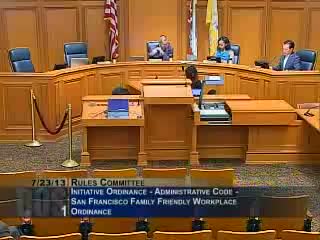
Rules Committee sends caregiver scheduling ordinance to full board for July 30 consideration
Summary
The Rules Committee voted without objection to move an ordinance to the full Board of Supervisors that would let San Francisco–based employees request flexible or predictable work arrangements for caregiving; proponents said amendments balance employee requests with employer business‑reason denials and authorization of enforcement by the Office of Labor Standards Enforcement.
The San Francisco Rules Committee voted Tuesday to send an ordinance to the full Board of Supervisors that would allow city‑based employees to request flexible or predictable working arrangements to assist with caregiving.
President Chu, the measure’s sponsor, told the committee this was the third hearing and said the proposal ‘‘would establish in San Francisco the right for employees to request of employers, the opportunity to talk about flexible working arrangements if those employees are parents and caregivers.’’ He said the right to request would be ‘‘balanced by an employer’s right to deny for good faith business reasons’’ and described a suite of implementation details the ordinance would include.
The measure as read by the Clerk would also: prohibit adverse employment actions based on caregiver status; prohibit interference and retaliation; require employers to post a notice informing employees of their rights; require employers to maintain records regarding compliance; authorize enforcement by the Office of Labor Standards Enforcement; and allow waivers of the ordinance’s provisions in a collective‑bargaining agreement. The item description included a proposed ballot date of Nov. 5, 2013.
Ron Smith of the Hospital Council told the committee, ‘‘We just want to thank President Chu and the members of this committee for your incredible patience and your understanding in trying to make the best piece of legislation possible.’’ Chair Supervisor Norman Yee praised the outreach and amendments, noting the committee had moved ‘‘the minimum of 10 to 20’’ during negotiations to reduce burdens on smaller employers.
A motion to move the item out of committee with a positive recommendation to the full Board was made and seconded; President Chu asked that it be scheduled for the Board’s July 30 meeting to allow additional stakeholder conversations and to preserve the option to vote to place the measure on the ballot at that full‑board meeting. With no objection, the motion was approved.
The Rules Committee did not take a final vote on the ordinance text; the committee moved the item to the full Board for consideration on July 30, 2013. If the Board votes at that meeting to place the ordinance on the ballot, the measure would appear on the Nov. 5, 2013 election per the item description.
Action items: the committee transmitted the ordinance to the full Board for consideration on July 30; further stakeholder discussions were acknowledged by the sponsor and staff.