Get Full Government Meeting Transcripts, Videos, & Alerts Forever!
Get email alerts on the Municipal Broadband topic
No spam. Unsubscribe anytime.
Budget analysts urge broader study as supervisors weigh Google/EarthLink Wi‑Fi deal
Summary
Budget analysts told the Budget & Finance Committee a municipally owned wireless network could be feasible but recommended a broader RFP and more community outreach. The committee heard hours of public comment on the proposed Google/EarthLink agreement, with advocates urging rapid rollout and critics seeking stronger privacy, competition and digital‑inclusion guarantees.
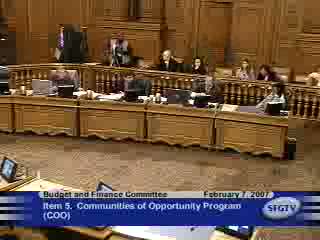
The Budget & Finance Committee heard competing recommendations and a large public record on a proposed citywide wireless Internet arrangement and on whether the city should pursue a municipally owned broadband network.
The Board—s budget analyst office presented a fiscal feasibility study that found a municipally owned wireless network "could be fiscally feasible" under some assumptions but carries notable financial and technical risks. The memo estimated capital deployment costs in the $6–$10 million range and recurring operations and maintenance of $1.5–$2.0 million annually. The analysts modeled conservative revenue assumptions (3–5 percent household uptake at a $10/month user rate) and produced a wide range of net outcomes from an annual shortfall of about $1.4 million to a net gain of roughly $900,000 depending on uptake and unquantified advertising and grant income.
The study also reviewed the pending EarthLink/Google proposal and flagged concerns: the free basic service tier would grant Google primary access to that audience, basic tier speeds would be roughly one‑fifth typical DSL speeds, customers might need to buy a customer premise device (estimated $80–$200) to use service in some multi‑story buildings, and EarthLink serving as both wholesale network operator and a retail ISP could create conflicts that limit competition. The report recommended reissuing an RFP that allows multiple business models (municipal ownership, public–private partnership, nonprofit consortium), incorporating the recent fiber‑to‑the‑premises feasibility work, and expanding community outreach and a digital inclusion plan.
Public comment extended for hours and presented sharply divergent views. Supporters — including technology vendors, many business representatives, community organizations and residents — urged the committee not to delay rollout, saying the Google/EarthLink investment would bring free basic access now to many low‑income residents, provide private capital and reduce the city's fiscal risk. Witnesses from community tech centers, neighborhood nonprofits and program providers emphasized immediate needs for connectivity in schools, community centers and homes and asked the board to create a dedicated digital‑inclusion fund.
Opponents and privacy advocates urged deeper study and stronger contractual terms. The ACLU and several community groups urged amendments to the EarthLink/Google agreement to limit data collection, give users opt‑out controls, spell out enforceable service level agreements and avoid long exclusivity that could stifle competition. A number of speakers urged the board to consider a municipal option or a hybrid model that preserved long‑term city control and ensured future upgrades and interoperability with fiber deployments.
After extended debate the committee voted to continue Item 6 (the feasibility analysis) for more study and forwarded Item 7 (a resolution urging evaluation of municipal ownership and other safeguards) to the full Board by roll call (Dufty: no; McGoldrick: aye; Ammiano: aye). Several supervisors pledged to seek a near‑term supplemental appropriation to fund an immediate digital‑inclusion line item so training, low‑cost hardware and community tech centers can begin expanding access while the policy debate continues.
The committee chair said the budget office—s recommendations — reissuing a broader RFP that allows multiple business models, incorporating the fiber study and funding digital inclusion now — represent a path for the city to both capture near‑term benefits and preserve options for future municipal infrastructure decisions.