Get email alerts on the Parking Revenue Audit topic
No spam. Unsubscribe anytime.
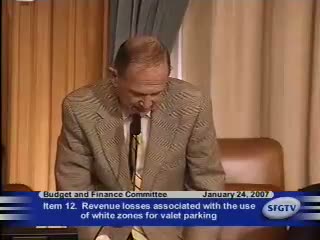
Budget Analyst, MTA and Controller Discuss Low Meter Collections; Controller Offers Limited Audit of White Zones and Valet Permits
Summary
Budget analyst and MTA reported unusually low paid occupancy and reconciliation discrepancies in parking meter data; the Controller—s Office offered a limited-scope audit and the committee asked staff to pursue reconciliation, enforcement and targeted work on white-zone/valet revenue.
The committee opened a multi-part review of parking-meter revenue and white-zone/valet parking. The Budget Analyst reported that weighted average paid-occupied meter hours suggested the city was collecting roughly 22.3% of maximum potential revenue based on available data and that Zone 1 (downtown core) showed a particularly low figure—about 0.87 paid hours per day under a 13‑hour pricing period (Ken Bruce / Budget Analyst Office). The analysis identified a growing gap between what the parking-management system reports and actual deposits; budget staff and MTA confirmed a reconciliation difference on the order of roughly $600,000 in the presented year.
MTA and Municipal Transportation Agency representatives (Judson True) identified multiple contributing factors: nonoperational or out-of-service meters, use of disabled placards (which state law permits for free meter parking), multiple "color code" curb uses (yellow/white zones and tow-away restrictions), motorcycle parking, and uneven enforcement; MTA is piloting meter technology and expects to increase enforcement capacity with additional parking-control officers. The Controller—s Office (Monique Zamuda) offered to perform a limited-scope audit to sample occupancy, reconcile deposits with system records, and review internal controls for the coin-collection and deposit process.
The committee asked staff to pursue a coordinated review of broken meters, enforcement staffing and parking management system mapping, to provide a breakdown of the currently labeled 1,989 white zones (most in a miscellaneous category), and to examine the financial impact of white zones used by for-profit valet operations. Supervisors flagged the public-asset value of on-street space and urged pursuit of cost-recovery where white zones replace meter revenue. The committee kept the items live for further work and follow-up audit planning.
AI generated
The text on this page is AI generated. Summaries, highlights, analysis, and video transcripts are all produced from the original source material.
AI can make mistakes, so if you spot one, and we will fix it for everyone.
Note: the source content is unaltered by us. Any content source we link to, be it a video, an audio recording, or a document, is presented exactly as its publisher released it. That publisher is usually a government body, sometimes an individual official or another organisation.