Get Full Government Meeting Transcripts, Videos, & Alerts Forever!
Get email alerts on the Treasure Island Redevelopment topic
No spam. Unsubscribe anytime.
Supervisors endorse Treasure Island plan in principle, attach conditions on transport funding and resident protections
Summary
At a joint Board of Supervisors committee hearing, members moved to endorse the Treasure Island development plan and term sheet while adding conditions that require clearer transportation governance, independent fiscal analysis and protections for existing island residents; the amended resolution will be forwarded to the full board.
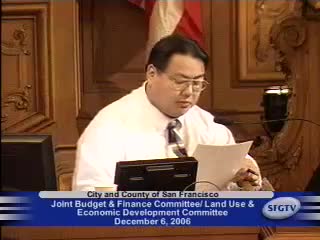
A joint meeting of the San Francisco Board of Supervisors’ Budget & Finance and Land Use & Economic Development committees moved Wednesday to endorse the Treasure Island development plan and term sheet, but only after attaching a package of conditions aimed at protecting city finances, clarifying transportation governance and preserving housing for current island residents.
The committee’s action, taken after more than four hours of presentations and public comment, asks that the Treasure Island Development Authority and Treasure Island Community Development (TICD) secure or identify state legislation or an alternative that implements the plan’s congestion- and parking-pricing tools without relying on San Francisco’s general fund. The committee also required that the final disposition and development agreement (DDA) include a transportation plan that has been reviewed and approved by the Board of Supervisors or its designee and that the DDA’s fiscal analysis reflect municipal and county costs and sensitivity testing of key assumptions.
"Our job with public-private partnerships like this is to try to create the greatest public benefits possible at the same time minimizing the risk of an adverse impact to the general fund," Michael Cohen said in introducing the plan. He told supervisors that the plan embeds public benefits into infrastructure costs so those benefits must be delivered before TICD receives a return.
TICD partner Jay Wallace and development executives described the land-use vision for Treasure Island and Yerba Buena Island: up to 6,000 homes, a retail spine linked to a ferry key, about 300 acres of parks and a sustainability program the presenters said was designed to meet LEED ND gold-level standards. Wallace said the plan depends on a combination of private capital, tax-exempt financing and project-generated revenues to pay roughly $1.2 billion of horizontal (infrastructure) costs.
Jack Sylvan, describing the financing structure, said tax increment and Mello-Roos-like mechanisms are expected to generate roughly $700 million and that private land sales and leases would supply the rest. "All of the sources of these funds are project-generated, meaning they're the result of private capital and the redevelopment project itself," he said.
City budget analyst Christine Martin told supervisors that the fiscal projections rest on numerous assumptions. She flagged a potential operating deficit for Muni bus service and noted the plan projects an internal rate of return in the range TICD seeks. "Small variations in these assumptions could result in significant changes to the projections," she said.
Public comment was primarily supportive but included repeated cautions about transportation funding, tree and wetlands protection, and ensuring replacement housing for existing island residents. Sherry Williams of TieDye (Treasure Island Homeless Development Initiative) and other nonprofit housing providers urged enforceable commitments for replacement and supportive housing. Ruth Gervanis of the Treasure Island Wetlands Project pressed for an ecological management plan for Yerba Buena Island’s habitats.
Supervisor Chris Daley, speaking for several supervisors, made resident protection a central condition: "Any household on Treasure Island at the date of the execution of the DDA shall be provided the option to rent a comparable unit at their rent at the time of the execution of the DDA," he said, adding that annual rent changes should follow the Rent Board’s established rules.
On governance, Supervisor McGoldrick moved—and the committee agreed—to add language requiring that, before entering the DDA, TIDA pursue state legislation (or an alternative solution not relying on the general fund) to implement the congestion- and parking-pricing programs and that any such legislation or alternative be subject to prior Board approval. The committee also required that the Board of Supervisors or its designee be assigned responsibility for implementing and monitoring the transportation program and that the project sponsor report back on progress semiannually.
The committee’s amended resolution lists several conditions precedent, including: updated fiscal analysis and sensitivity testing developed in collaboration with relevant city departments; a financing plan that ensures incremental general fund support for Muni does not exceed baseline incremental revenues; inclusion of a management plan for the natural areas on Yerba Buena Island; and a procedure for TIDA/TICD to document and fund any unreimbursed predevelopment costs incurred by the city.
Votes at a glance - Motion: Amend and forward an endorsement of the Treasure Island development plan and term sheet to the full Board, subject to conditions on transportation governance, fiscal analysis and resident protections. Moved by Supervisor McGoldrick, seconded by Supervisor Peskin; forwarded by committee without objection.
What happens next The committee’s recommendation will go to the full Board of Supervisors for final consideration. If the DDA returns in the future with materially different assumptions or if the conditions are not met, supervisors said they expect to retain the authority to decline final approval. TIGD and city staff told supervisors they will continue to update the fiscal analysis and work with city departments as the DDA is drafted.
Why this matters The plan promises extensive public benefits—thousands of affordable housing units, large open spaces and new transit—but also requires heavy up-front infrastructure spending and a complex financing structure. The committee’s conditions aim to keep the city’s elected body in control of key fiscal and governance decisions as the project moves from concept to binding agreements.