Get Full Government Meeting Transcripts, Videos, & Alerts Forever!
Get email alerts on the Performance Measures Hearing topic
No spam. Unsubscribe anytime.
Supervisors continue performance-measures hearing, push for fewer outcome-focused metrics
Summary
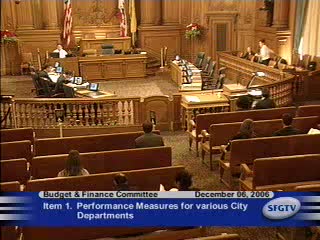
At a special Budget & Finance Committee hearing Chair Chris Daley and the controller’s office pressed departments to move from process-counts toward fewer, outcome-oriented performance measures; the committee continued the item to Dec. 7 for final revisions.
At a special meeting of the San Francisco Board of Supervisors’ Budget & Finance Committee, Chair Chris Daley convened a continuation of citywide performance-measure hearings focused on moving departments toward fewer, more outcome-oriented metrics. Peg Stevenson of the Controller’s Office told supervisors that departments “have worked hard since September to refresh and add new performance measures and make sure that we had corrected targets,” and described the central database as the city’s current reporting mechanism.
The hearing covered measures across multiple service areas — from public works and planning to transportation and the airport. Supervisors repeatedly asked departments to add contextual economic indicators (for example, unemployment or sector-specific data) so that department-level measures could be interpreted against citywide trends. Chair Daley said contextual measures could help the board decide whether additional budgetary support was warranted.
Several recurring themes emerged: standardize language-access reporting across departments, prefer outcome measures over simple process counts, and create shared measures for services that span agencies (for example, small-business assistance and permit processing). The Controller’s Office and departments agreed to continue refining measures through February to align with the budget submission schedule.
Departments gave varied updates. The Planning Department described recent staffing turnover and a drive to improve permit tracking and qualitative outcomes; the Public Utilities Commission noted a renewed emphasis on asset management after years of deferred maintenance; the MTA described staffing shortages and absenteeism as key constraints on on‑time performance; and the Taxi Commission said it will survey taxi response times and consider adding taxi-mode metrics to modal-share calculations.
After public comment from Francisco DeCosta urging common evaluation elements across departments, the clerk moved to continue the hearing to December 7. The committee carried the continuation without objection. The committee said it will reconvene with revised measures and additional departmental clarifications then.