Get Full Government Meeting Transcripts, Videos, & Alerts Forever!
Get email alerts on the Public Health topic
No spam. Unsubscribe anytime.
Board committee urges shift from process counts to outcome measures; Health Department offers examples
Summary
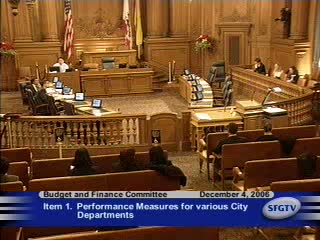
The Budget & Finance Committee examined departmental performance measures and heard the Health Department argue that process counts (clinic visits, immunizations) are accurate but do not show whether services improve health; DPH urged adding outcome benchmarks such as kindergarten immunization surveys.
The Board of Supervisors Budget & Finance Committee met in a special session to review and standardize departmental performance measures across city agencies. Dr. Mitch Katz, Director of the San Francisco Department of Public Health, told the committee that while the department’s process-level data — patient days, clinic visits, doses given — are “absolutely accurate,” they often fail to show whether services are achieving health outcomes.
Katz offered immunizations as a concrete example: the raw count of injections fell in recent years not because the health system failed but because several childhood vaccines have been combined into single shots. “Our number of immunizations falls because for a very positive reason that more and more of the immunizations are combined in one shot,” Katz said. He recommended tracking outcome-focused benchmarks such as the percentage of children fully immunized, using the kindergarten retrospective survey methodology to assess coverage over time.
Supervisors pressed for measures that distinguish service volume from effectiveness and for technical fixes to the department’s IT coding so counts reflect unduplicated patients rather than individual vaccine doses. Katz said updating IT codes to identify multi-vaccine codes is “entirely doable,” and recommended pairing a smaller set of outcome indicators with existing process metrics to create a clearer “report card” on departmental performance.
Committee members also asked about adding measures of adverse outcomes and negative indicators, including malpractice claims or patient complaints, to provide a fuller picture of performance. Katz said patient-safety items are tracked and that HHS policy favors openness about errors, both for ethical reasons and because transparent disclosure can reduce long-term costs.
The committee did not adopt new measures at the hearing; staff were directed to incorporate the committee’s guidance into revised performance packages the Controller and departments will submit ahead of budget deliberations in February.