Get Full Government Meeting Transcripts, Videos, & Alerts Forever!
Get email alerts on the Violence Prevention Supplement topic
No spam. Unsubscribe anytime.
Budget analysts urge reserve as supervisors advance $2.5M violence-prevention supplemental amid sharp debate
Summary
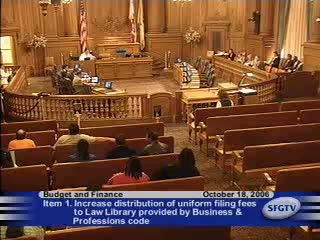
The Budget & Finance Committee forwarded a $2,511,746 supplemental appropriation for violence-prevention programs to the full Board while adopting the Budget Analyst’s recommendation to reduce and place funds on reserve. The hearing featured sharp exchanges over report timing, department hiring logistics, and public pleas to restore cuts to community-based programs.
The San Francisco Board of Supervisors Budget & Finance Committee voted to send an ordinance appropriating $2,511,746 for violence-prevention programs to the full Board with the Budget Analyst’s recommended adjustments — including a $253,657 reduction and placing funds on reserve until clearer expenditure projections were available.
Chair Chris Daly opened the hearing by pressing the Mayor's Office and department staff about delays that limited the Budget Analyst's report. Daly said a mayoral spokesperson had accused him of "playing politics with the city's public safety," an allegation that prompted several members — including Board President Aaron Peskin — to defend the role of the independent budget analysis. Noelle Simmons of the Mayor's Budget Office replied that her team "responded to every information request" and noted a sheriff's CFO vacation had slowed one department's submission.
Ken Bruce of the Budget Analyst's Office summarized the report and its recommendations: the ordinance would appropriate $2,511,746 from the general fund reserve for violence-prevention activities across four departments and the Budget Analyst proposed reducing the supplemental by $253,657 "from 2,511,746 to 2,258,089" and placing the funds on reserve so money would be released later if accurate expenditure projections justified it. The analyst also flagged that policing measures funded by the ordinance could increase court and jail-related costs elsewhere in city budgets.
Department witnesses described how the funds would be used. The Police Department described recent overtime deployments to hotspot areas and the civilianization of police service-aide (PSA) positions intended to free sworn officers for patrol; the chief said PSAs might be hired before January if airport laterals materialize. The Comptroller reported the police overtime account was already over budget and, if overtime continued at the current rate, could produce a deficit "between 5 and $7,000,000." Juvenile Probation Chief Bill Sifferman explained overtime funding would enable targeted supervision of minors during high-risk hours. Acting Adult Probation Chief Arturo Far said his department found 251 active probation cases aged 18–25 (81 of them gun-related) and requested three probation officers to focus on that cohort; he said overtime would help bridge hiring lead time.
Public commenters — including community-based organizations and faith leaders — urged reserve placement for the funds, objected to recent cuts to direct-service prevention contracts and called for investments in community programs rather than law-enforcement overtime. A representative of the Juvenile Justice Providers Association said the mayor's prior decisions had "defunded case management and all prevention programs" and called the mayor's supplemental a short-term suppression strategy that would not replace culturally competent community services. Several speakers asked that any police overtime be paired with contracted CBO partners.
In response to testimony, Supervisors divided the file and accepted a series of amendments: one divided file will be continued for two weeks while Budget Analyst staff prepare supplemental analysis of proposed position additions (including a proposal to add juvenile-probation positions that could expand to six positions after state reimbursement). Chair Daly and other supervisors accepted a package amendment and, "without objection," forwarded the primary supplemental ordinance to the full Board with the Budget Analyst's recommendations.
Next steps: the supplemental ordinance and the Budget Analyst's recommended amendments will go to the full Board for final consideration; one divided file was continued for two weeks so staff can provide additional fiscal detail and to consider proposed personnel amendments.