Get Full Government Meeting Transcripts, Videos, & Alerts Forever!
Get email alerts on the Human Services topic
No spam. Unsubscribe anytime.
San Francisco committee approves Human Services supplemental funding including food stamp, CalWORKs and child welfare dollars
Summary
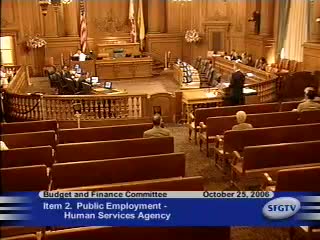
The Budget and Finance Committee accepted a supplemental appropriation that lets the Department of Human Services take a $999,993 federal food stamp grant and deploy roughly $10.8 million in state and federal funding for CalWORKs, child welfare, HMIS and related programs; a technical $80,968 reduction was applied.
The Budget and Finance Committee on an uncontested vote forwarded ordinances allowing the Department of Human Services to accept a $999,993 federal food stamp grant and to appropriate $10,756,557 in state and federal revenues for CalWORKs work participation, child welfare services, food stamp outreach, the Homeless Management Information System (HMIS) and workforce development programs.
Trent Rohrer, director of the Human Services Agency, told supervisors the package combines grant awards and state funds tied to federal TANF reauthorization. "We have before you a supplemental that I'm pleased to present," Rohrer said, describing a mix of investments including a food stamp grant to expand access by using web-based technology and roughly $4.1 million to expand CalWORKs activities that the agency expects will engage about "1,000 families." Rohrer said the child welfare portion is "a little more than $5,000,000" and funds efforts to reduce first entries to foster care, reduce re-entries, support emancipating foster youth and expand housing and childcare for relative caregivers.
The committee also addressed a technical error flagged by the budget office. The budget analyst recommended reducing the supplemental by $80,968 and approving the remainder and the salary-ordinance amendment to create 35.8 positions. The chair asked whether members concurred; the motion to accept the budget analyst recommendations (excluding a separate $1.6 million policy matter) was taken "without objection," advancing both items.
The budget analyst noted one policy question—whether increased state funds should be used to offset existing general-fund support—which the supervisors deferred for separate policy direction. Rohrer identified specific uses under consideration if the supervisors choose that approach, including adding 25 transitional housing units for emancipating foster youth, childcare subsidies for relatives who cannot receive federal reimbursement, orthodontia for foster children and modest facility improvements to house new staff without new leases.
Committee action: the ordinances and salary-ordinance amendment were forwarded by consensus, with the $80,968 technical reduction applied; the policy question about using state dollars to offset general fund was deferred for supervisor direction.
What happens next: the supplemental appropriation and salary-ordinance amendment will proceed through whatever remaining administrative and board steps remain for formal adoption and implementation details will be subject to the policy direction supervisors may provide on the use of state funds.