Get Full Government Meeting Transcripts, Videos, & Alerts Forever!
Get email alerts on the Campaign Finance Ordinance topic
No spam. Unsubscribe anytime.
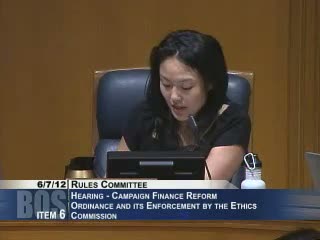
Supervisors refer draft campaign‑finance ordinance back to Ethics Commission after broad public pushback
Summary
Supervisor Wiener’s proposed amendments to the city’s campaign rules drew sustained public criticism for weakening disclosure and 24‑hour reporting; the Rules Committee voted to continue and re‑refer the ordinance to the Ethics Commission for additional public hearings and revisions.
Supervisor Wiener introduced an ordinance to amend the city’s campaign and governmental contact code to streamline disclaimers, align local disclosure with state law, index the local $500 contribution limit to inflation and remove an overall cumulative contribution limit. Wheeler said some changes respond to constitutional concerns and practicalities of ranked‑choice voting and campaign administration.
The proposal generated significant public opposition. Dozens of community members, former Ethics Commissioners and members of reform groups warned that the draft language would reduce transparency by eliminating 24‑hour pre‑election reporting, raising or changing thresholds that could exempt robocalls and independent ads under $5,000 from timely disclosure, and removing limits that prevented coordinated contributions to many candidates in a single race.
Speakers urged robust outreach and multiple interested‑persons hearings; they cited examples where modest sums could buy substantial reach (robocalls or targeted ads) and warned that exemptions would reopen historic loopholes. Former commissioners and task‑force members urged clearer drafting, steps to prevent bundling and shell committees, translated guidance for non‑English speakers and stronger enforcement resources.
In light of the public testimony and technical concerns, the committee voted to continue Item 7 to the call of the chair and requested the Ethics Commission take the draft up again for a broader public engagement process, to clarify drafting conflicts with state law and to return with recommendations. No ordinance amendments were adopted at this meeting.