Get Full Government Meeting Transcripts, Videos, & Alerts Forever!
Get email alerts on the Ethics Audit topic
No spam. Unsubscribe anytime.
Budget office report prompts Rules Committee to seek ethics commission review of campaign finance enforcement
Summary
A Budget and Legislative Analyst report comparing San Francisco and Los Angeles prompted an extended Rules Committee hearing on campaign finance enforcement, disclosure and Ethics Commission staffing. After public testimony urging stronger enforcement and transparency, the committee continued the matter to the call of the chair and asked the Ethics Commission to hold a public process.
A Budget and Legislative Analyst report comparing San Francisco and Los Angeles’ campaign‑finance and ethics regimes drew extensive public testimony and led the San Francisco Board of Supervisors Rules Committee to continue its review and ask the Ethics Commission for a fuller public process.
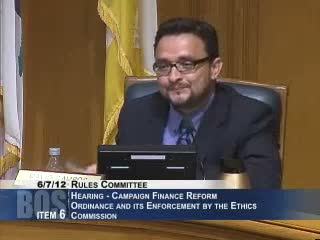
Supervisor David Campos, who requested the audit, opened the hearing by saying the purpose was not to attack the Ethics Commission but to identify where San Francisco could strengthen enforcement, disclosure, lobbying rules and public education. Fred Brusseau of the Budget and Legislative Analyst’s office presented the report and its key takeaways.
The report found no uniform winner between the cities; it identified areas where Los Angeles has stricter rules — for example, LA bars lobbyists from making any contributions and imposes a 12‑month blackout for contractors after contract award, compared with a six‑month window in San Francisco — while San Francisco has stronger lobbyist reporting thresholds, monthly lobbying reports and an outright corporate contribution ban. The analysts also flagged differences in reporting frequency, contribution limits and the treatment of independent expenditures. They reported that San Francisco’s Ethics Commission had a substantially higher dismissal rate for complaints in the period reviewed and lower reported average penalties than Los Angeles.
The presentation prompted detailed questions from committee members about the report’s scope and whether staffing and procedural differences were accounted for; Brusseau said staffing comparisons were not part of the brief assignment but could be added if requested.
Public commenters — including current and former members of the Sunshine Ordinance Task Force, former Ethics Commissioners, advocacy groups and residents — urged more robust enforcement, more timely disclosure (including 24‑hour reporting for certain independent expenditures), better resource allocation and more accessible information in languages other than English. Several speakers cited dismissal rates, the need for audits of closed files and loopholes that allow bundled or opaque contributions to flow into local politics.
Supervisor Campos moved and the committee agreed to continue the item to the call of the chair with a request that the Ethics Commission review the report, hold a meaningful, multi‑session public engagement process and return recommendations to the Board. The committee also asked staff to provide any further analysis members request, such as staffing comparisons or additional jurisdictional benchmarks.
The next steps are procedural: the committee’s continuation preserves the record and directs the Ethics Commission to consider the report’s findings and to solicit public input. No new ordinances or penalties were adopted at the meeting.