Get Full Government Meeting Transcripts, Videos, & Alerts Forever!
Get email alerts on the Campaign Finance topic
No spam. Unsubscribe anytime.
Rules Committee advances changes to San Francisco's public campaign finance rules and a ballot backup
Summary
The Rules Committee on Feb. 23 forwarded two related measures—an ordinance and a ballot initiative option—to adjust San Francisco's public campaign financing program after the U.S. Supreme Court's ruling in Arizona Free Enterprise Club v. Bennett; the committee sent both items to the full Board without recommendation and requested coordination with the Department of Elections on related deadlines.
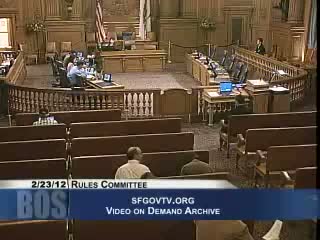
Chair Jane Kim opened the Rules Committee meeting Feb. 23 by saying, "These, the 2 items that are before us today are largely similar," and framed the proposals as the city's response to the U.S. Supreme Court's decision in Arizona Free Enterprise Club's Freedom Pack v. Bennett. The committee voted to forward both an ordinance and an initiative-version of the changes to the full Board of Supervisors without recommendation and as a committee report.
The two measures would amend the city's Campaign and Governmental Conduct Code and the Municipal Elections Code to change qualifying thresholds for public financing, adjust spending caps, delay the disbursement of public matching funds until after candidate filing, reduce matching ratios, and move nomination filing deadlines earlier in the calendar. John St. Croix, director of the Ethics Commission, told the committee "the first proposal does have the the full backing of the ethics commission," saying the commission conducted interested-person meetings and public outreach while trying to preserve the program's integrity and attractiveness to candidates.
Under the proposals discussed, supervisor candidates' qualifying contributions would rise from $5,000 to $10,000 (from at least 100 San Francisco residents); incumbent supervisor candidates would have a higher threshold (described in the transcript as $15,000 from at least 150 residents). The measures would keep the mayoral qualifying amount at $50,000 but the transcript did not consistently specify the resident-count associated with that mayoral threshold; the chair said an incumbent mayor would be required to collect $75,000 from at least 750 residents. The committee also discussed changing the timing of public-fund disbursements so funds would not be made available "no earlier than a hundred and 42 days before election," and the draft was revised so disbursement would instead occur one week after the filing deadline to reduce incentives for so-called "zombie" candidates to remain in races.
The proposals would also change the matching formula, reducing matching from 1-to-4 to 1-to-2, and require nomination documents to be filed earlier (the transcript cites filing no later than 146 days before the election). Ethics Commission staff told the committee candidates may prequalify administratively earlier, but St. Croix confirmed they "can't receive disbursement till later," which he said should ease the workload of the Ethics Commission.
Deputy City Attorney Andrew Shen answered procedural concerns about whether combining campaign-finance amendments and municipal-election code changes violated the single-subject rule. "There is no single subject problem with either proposal," he said, explaining the amendments affect separate code sections for the single purpose of addressing filing and financing timing. That legal opinion directly addressed public comments by attorney David Pilpel, who warned the measures may mix subjects and could burden the Department of Elections as signature-verification and canvass work overlaps with earlier filing deadlines.
Peg Stevenson of the Controller's Office told the committee the fiscal baseline remains unchanged: "the budgeting is based on the $2.75 per head population that the city is required to appropriate every fiscal year." She noted that per-election expenditures could vary but the annual appropriation requirement (cited in the transcript at about $1,800,000) would not change.
Supporters at the hearing, including representatives of California Common Cause and the Asian American Action Fund, urged adoption of the Ethics Commission's approach. Stephen Hill, who said he helped draft the original program, summarized how the Supreme Court ruling removed prior triggers: "Previously, candidates could receive more money if a privately financed candidate broke the spending cap, but as a result of the Supreme Court ruling that got rid of these triggers, publicly financed candidates would not be able to receive more money," and he endorsed modest increases to spending caps as a practical response.
After public comment and brief amendments to correct a minor typographical error in the legislative findings, Supervisor David Campos moved to forward both items to the full Board without recommendation and as a committee report; the committee incorporated the small amendment and did so without opposition. Chair Kim asked staff to set up a meeting with the Department of Elections to identify which related deadlines would need revision if the ordinance is adopted.
The committee recessed into closed session on separate litigation items and, on reconvening, the City Attorney reported closed-session discussion concerned pending claims and litigation; the committee voted to keep the closed-session discussion confidential and to move certain closed-session items forward under the regular process. The Rules Committee's actions send the campaign-finance ordinance and its ballot backup to the full Board for consideration; the items are scheduled to appear on the March 6 Board agenda for further action.