Get Full Government Meeting Transcripts, Videos, & Alerts Forever!
Get email alerts on the Elections topic
No spam. Unsubscribe anytime.
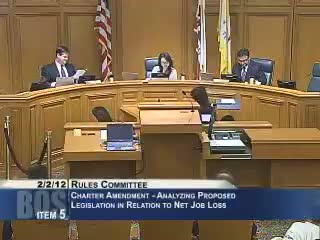
Rules Committee sends competing charter measures on ranked‑choice voting and election consolidation to full board after lengthy public comment
Summary
The committee heard competing charter amendments to repeal ranked‑choice voting and to consolidate city elections; the Controller provided fiscal estimates and the panel forwarded both measures to the full Board of Supervisors without recommendation.
The Rules Committee on Feb. 2 examined two competing charter amendments on how San Francisco conducts municipal elections and how to implement ranked‑choice voting (RCV).
Controller Peg Stevenson presented fiscal analyses comparing the options. The office estimated that eliminating RCV could save about $660,000 in direct costs associated with RCV implementation, but adding a runoff election would add about $3.3 million in variable election costs — yielding a net projected increase of roughly $2.6 million under a switch to runoffs, by the office's simple math. On consolidation, the controller estimated an aggregate savings of about $4 million over a four‑year cycle (about $1 million per year) if certain municipal elections were consolidated.
The items prompted extended public comment from business groups, labor, senior advocates, election reform organizations and individual residents. Jim Lazarus of the Chamber of Commerce urged consolidation and a return to runoffs; multiple unions including SEIU and senior groups urged retaining RCV and improving voter education. Speakers raised turnout and equity concerns, with proponents of RCV warning that September primaries or off‑cycle runoffs historically produce much lower turnout and may disproportionally reduce participation among minority voters.
John Arndt, director of the Department of Elections, answered technical questions about scheduling, overseas ballots and operational constraints, noting recruitment challenges for high‑school poll workers if a primary is scheduled late in summer and the need for sufficient lead time to test equipment and distribute absentee ballots.
After hearing the controller's analysis and broad public testimony, the committee voted to send both charter amendments to the full Board of Supervisors with no committee recommendation so the full board can consider them with additional input and hearings.