Get Full Government Meeting Transcripts, Videos, & Alerts Forever!
Get email alerts on the Election Reform topic
No spam. Unsubscribe anytime.
Heated Public Debate Over Ranked-Choice Voting: Supervisors Continue Two Competing Charter Proposals
Summary
Two competing charter amendments on ranked-choice voting — one to repeal it and return to runoffs, another to strengthen and expand RCV education and rankings — drew hundreds of speakers. The committee accepted amendments and continued both items for further work and public outreach.
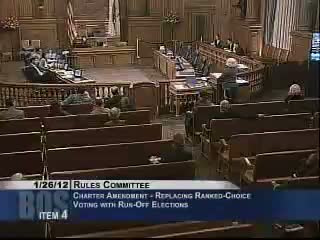
The Rules Committee devoted the latter portion of its Jan. 26 meeting to two competing charter proposals on how San Francisco conducts municipal elections.
Supervisor John Farrell introduced a measure to repeal ranked-choice voting and return to a two-round runoff system; Farrell later offered substantive amendments that would move the first round to September with a November runoff and require a 60–65% threshold to avoid a runoff, and delay effect until 2013. Supervisor David Campos (with Supervisor Avalos) proposed a countermeasure that would keep ranked-choice voting but clarify that voters can rank as many candidates as the voting machine permits and commit additional resources to outreach and education in neighborhoods with low turnout.
Public testimony was extensive and sharply divided. Proponents of retaining and improving ranked-choice voting, including the Asian Law Caucus, Common Cause, the Sierra Club, the League of Pissed-Off Voters and many community groups, cited higher November turnout versus past December runoffs, an increase in elected officials from minority communities since adoption, and budget savings (cited figures near $7 million in cumulative savings). "Ranked-choice voting has remedied critical deficiencies of plurality/runoff systems," said Carolyn Hsu of the Asian Law Caucus.
Opponents questioned whether RCV is truly "majoritarian," pointed to voter confusion for some voters and to cases in other cities where late reporting or equipment limits created concern. Several technical experts proposed alternatives such as approval or score voting, and some recommended adjustments to candidate-filing deadlines and public-financing rules to address campaign dynamics.
Supervisor Farrell—s amendments were accepted for consideration, and committee members agreed to continue both charter measures to a future Rules Committee meeting so the Board and the public can evaluate amendments, outreach plans and fiscal impacts.
Next steps: Both items were continued for further amendments, outreach and fiscal analysis; supervisors emphasized voter-education investments and consideration of possible public-financing and candidate-deadline changes to address concerns raised during the hearing.