Get Full Government Meeting Transcripts, Videos, & Alerts Forever!
Get email alerts on the Shelter Monitoring topic
No spam. Unsubscribe anytime.
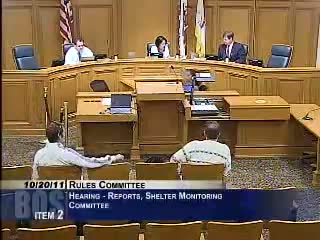
Rules Committee presses HSA and DPH on shelter turn-away counts, training and language access
Summary
The Shelter Monitoring Committee reported 67 standard-of-care complaints, two investigations forwarded to DPH and a turn-away finding that fewer than half of 303 clients observed received reservations; HSA and DPH acknowledged data and staffing limits and agreed to follow up on methodology, training lists and Spanish-language capacity.
The Rules Committee on Oct. 18 reviewed the Shelter Monitoring Committee’s quarterly and turn-away reports and pressed the Human Services Agency (HSA) and Department of Public Health (DPH) to reconcile methodological discrepancies about vacancies, reservation requests and training compliance.
Matt Luton, secretary of the Shelter Monitoring Committee, said the committee completed 31 of 33 assigned inspections for the quarter, recorded 67 standard-of-care complaints and forwarded two investigations to DPH. He said the committee is behind on eight investigations, citing staffing shortages and a lack of Spanish-language capacity, and estimated training compliance at about 49%.
Luton also presented a turn-away survey based on February–March observations at three reservation locations. Of 303 clients seeking shelter during those observations, fewer than 50% received a reservation; on March 11 the committee recorded 64 vacant beds and 84 clients unable to get a reservation. “Of the 303 clients seeking shelter, less than 50% were provided a reservation,” Luton said.
Scott Walton, manager of adult programs in HSA’s housing and homeless division, told the committee HSA has found limits in comparing the turn-away counts with nightly vacancy counts because the reservation system records only completed reservations, not requests, and because bed types change during the day. “We only know if a reservation is made and that’s what holds the bed for the person until check-in curfew,” Walton said, explaining the system cannot track requests made throughout the day.
Walton also said tokens (transportation vouchers) are a partially funded policy and that HSA provides them according to a prioritization policy; HSA estimated roughly 1,000 tokens per month versus more than 1,000 adult shelter beds in the system, and said full coverage of transportation needs would cost more than current funding allows.
DPH representative David Nakanishi said DPH provides staff to the Shelter Monitoring Committee and is working to restore Spanish-language staff capacity; one staffer expected to return Nov. 1. Both HSA and DPH agreed to follow up with the Shelter Monitoring Committee to clarify methodologies for the turn-away and vacancy comparisons and to provide more complete training data to the Rules Committee.
Providers and advocates who testified described heavy client needs, medically fragile and mentally ill residents, staff assaults and frequent staff turnover, and urged a cross-agency problem-solving group to address service and staffing gaps. Chair Kim proposed continuing Item 2 to the call of the chair to allow methodological questions to be resolved before the report is presented to the Board.
The committee did not adopt new policy during the hearing; HSA and DPH committed to follow-up reports and documentation for the committee’s review.