Get Full Government Meeting Transcripts, Videos, & Alerts Forever!
Get email alerts on the Parks Access topic
No spam. Unsubscribe anytime.
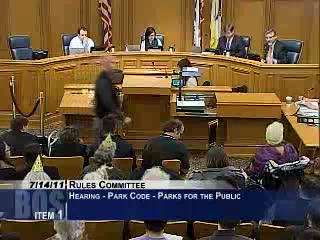
Supervisor Avalos’s parks initiative draws broad public comment over privatization and budget trade-offs
Summary
Supervisors heard dozens of public commenters and department testimony on the 'Parks for the Public' ballot measure, which would bar new long-term leases of clubhouses and stop new general-entry fees; Rec & Park officials warned the measure’s breadth could cost millions and limit partnerships that keep facilities open.
Supervisor John Avalos introduced a ballot initiative he called “Parks for the Public,” telling the Rules Committee the measure would protect public access to parks by prohibiting new long-term leases of recreation facilities and barring new general-access entry fees. Avalos said the proposal responds to examples in which public investments appear to have produced facilities that are not open to the general public, singling out the Cayuga clubhouse renovation as a case where residents fear access could be limited.
The measure’s language, Avalos said, is intended to preserve facilities “that should offer general public access,” and to prevent future conversion of clubhouses and other recreational facilities into long-term exclusive uses. He emphasized the initiative is not intended to block routine permits such as birthday parties: “This is about ongoing takeaways of our clubhouses…which should offer general public access,” he said.
Phil Ginsberg, general manager of Recreation & Park, told supervisors the department’s operating budget is about $115 million and that roughly 37 percent of its budget—about $43 million—comes from earned revenue. He and other department witnesses warned that, depending on legal interpretation, the initiative could reduce department revenues by an estimated $13 million over five years, and limit programming and partnerships that provide roughly 25,000 hours of nonprofit programming in clubhouses annually. “We have been asked to solve for $43 million in general fund reductions,” he said, adding that earned-revenue increases of about $6 million in recent years had preserved programs.
Members of the public were sharply divided. Supporters argued the initiative would stop what they described as creeping privatization, keep parks free to use and protect neighborhoods from exclusive commercial deals. One speaker for the Golden Gate Park Preservation Alliance said the measure “is shining a light on issues and problems that have been hidden and … it deserves to go forward.”
Opponents—including Rec & Park staff, nonprofit partners and small-business concessionaires—said the language is vague and risks unintended consequences. The Neighborhood Parks Council and the San Francisco Parks Trust urged reworking the measure’s language and adding funding or implementation detail, calling it an unfunded mandate that could produce layoffs or reduce services. A Rec & Park staff member said clubhouses averaged more than 3,000 community events and that most partnerships are with nonprofit public-benefit organizations that help keep centers open.
Supervisors repeatedly pressed the author on drafting details: how the ordinance defines “lease” versus a short-term permit, whether the effective date is intended to prevent imminent contracting, and whether the ballot wording would allow the board or staff to continue routine uses the measure does not aim to stop. Michael Martin, representing the America's Cup event authority, warned that unclear language could complicate Marina Green plans for the 2012 event.
The committee did not take a formal vote. Chair Jane Kim closed public comment and the author said he would take testimony and technical concerns under consideration.
Ending: The measure will proceed to further drafting and outreach; supervisors signaled they expect follow-up discussions with Rec & Park, the city attorney’s office and community stakeholders before final placement on the ballot.