Get Full Government Meeting Transcripts, Videos, & Alerts Forever!
Get email alerts on the Charter Amendment topic
No spam. Unsubscribe anytime.
Supervisor Weiner’s charter amendment to ease changes to voter‑adopted ordinances draws sharp public opposition; continued to June 2
Summary
Supervisor Wiener proposed a charter amendment to let the Board of Supervisors amend or repeal voter‑adopted ordinances after a staged time period; public speakers and advocacy groups warned it would erode the initiative power. Committee continued the item for further negotiation and analysis.
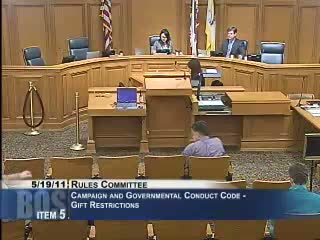
Supervisor Ross Weiner introduced a charter amendment at the Rules Committee on May 19 seeking to allow the Board of Supervisors to amend or, in some cases, repeal ordinances previously adopted by the voters after a set period.
Weiner told the committee the change is intended as a ‘‘modest step’’ to let elected officials correct technical problems without returning every small change to the ballot, proposing a time‑based approach: no board amendments during the first three years after adoption, a two‑thirds supermajority to amend or repeal in years four through seven, and broader authority after seven years; measures placed by citizen signature would not be subject to repeal, he said.
The proposal drew extensive public comment. Ray Hartz, director of San Francisco Open Government, said the amendment ‘‘guts’’ the initiative power by allowing the board to alter voter‑adopted ordinances after three years and warned it would permit removal of enforcement or other key provisions that make an initiative effective. Multiple speakers representing neighborhood groups, labor and civic organizations urged the committee not to forward the measure in its current form. Rachel Richmond, policy director for Professional and Technical Engineers Local 21, said the draft ‘‘opens the door’’ to changes that could undermine voter intent and predicted litigation over the measure’s limits.
Committee members asked for additional analysis of how many ordinances would be affected and whether a practical, enforceable distinction could be drawn between ‘‘technical’’ amendments and substantive repeal. Peg Stevenson of the controller’s office said a download of the Elections Department data indicated roughly 100 voter‑adopted ordinances might be implicated and offered to provide a more detailed analysis to the committee.
After extended public comment and discussion, Supervisor Weiner asked to continue the item to allow office‑to‑office meetings with interested parties; the committee agreed to continue the matter to Thursday, June 2.
Next steps: the author and city staff will confer with stakeholders and provide the committee with a tighter analysis of the ordinances and potential drafting alternatives ahead of the June 2 hearing.