Get Full Government Meeting Transcripts, Videos, & Alerts Forever!
Get email alerts on the Rent Board Reform topic
No spam. Unsubscribe anytime.
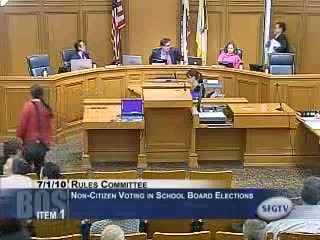
Rules Committee recommends rent-board appointment split after hours of divided testimony
Summary
The committee voted to send a charter amendment to the full board recommending split appointment authority for the Rent Stabilization and Arbitration Board, after conflicting public testimony from tenant advocates, landlords, rent-board officials and legal experts.
After hours of public testimony on July 1, the Rules Committee gave a positive recommendation to a charter amendment that would change how San Francisco’s Rent Stabilization and Arbitration Board is appointed and its membership composition. The measure — introduced and explained by Supervisor David Campos — would split appointment authority between the Board of Supervisors and the mayor, and set a five‑member voting composition with three tenant representatives, two landlord representatives and two neutral members (with an appointment process for the neutral seats). The committee’s positive recommendation will send the amendment to the full Board for further consideration.
Supporters, including tenant groups and the Mission SRO Collaborative, argued that the mayor’s exclusive appointment authority has produced an underrepresentation of tenants in a city where tenants are a majority of residents. "Tenants are greatly underrepresented specifically since we are the majority in San Francisco," said a representative of the Community Tenants Association, who urged the supervisors to pass the reform to better reflect the city’s demographics.
Opponents included the Professional Property Management Association of San Francisco (PPMA) and landlord‑representative groups, who warned the amendment would politicize a quasi‑judicial adjudicative body and expose the rent ordinance to litigation. Michelle Horneth Cohen, PPMA president, said the proposal would "dramatically" alter the balance that has governed rent‑board decisions for decades and could prompt costly legal challenges.
Multiple longtime rent‑board participants, including commissioner Bartholomew Murphy and Executive Director Deline Wolf, testified that the board acts primarily as an adjudicative body that applies existing ordinance law and pointed to low reversal rates in court as evidence the board currently operates within legal norms. Wolf described outreach work, multilingual materials and an array of community grant contracts used to reach tenants, while also warning that a structurally partisan commission could invite litigation that would jeopardize the ordinance’s stability.
Following debate, the committee took a roll call on a motion to forward the charter amendment with a positive recommendation; the record shows recorded votes that will be part of the committee report to the full Board.
The full Board will weigh the competing concerns — governance and representation on one hand, judicial impartiality and litigation risk on the other — as it considers whether to put the amendment before voters.