Get Full Government Meeting Transcripts, Videos, & Alerts Forever!
Get email alerts on the Transit Reform topic
No spam. Unsubscribe anytime.
Rules Committee advances broad MTA charter reforms including Inspector General, funding split and budget response
Summary
The Rules Committee advanced a package of charter amendments aimed at restructuring SFMTA oversight: creating an Inspector General with audit authority, clarifying the controller's retained roles, imposing a budget-response requirement for the MTA board, and proposing a property-tax set-aside conditioned on voter approval; final language will return to committee.
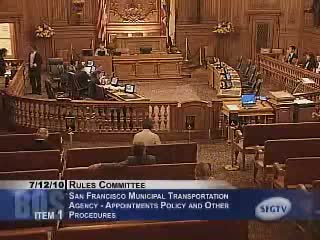
Supervisor David Campos, chair of the Board of Supervisors Rules Committee, moved July 12 to advance a package of charter amendments aimed at overhauling governance and oversight of the Municipal Transportation Agency (MTA).
Campos framed the changes as a comprehensive response to longstanding operational and accountability problems at Muni, saying, “this system is broken,” and proposing an independent Inspector General to conduct management and performance audits, review management practices and monitor agency performance. He said the measure is designed so the controller’s office retains core functions — technical assistance, whistleblower investigations and consumer satisfaction surveys — while the Inspector General would provide an internal auditing role specific to the MTA.
The measure includes specific funding mechanics. Campos proposed increasing the controller’s audit fund contribution to 0.4% of assessed value and splitting the increased allocation half-and-half between the controller’s audit fund and the office of the Inspector General. As a fallback, if the higher set-aside does not go into effect the proposal would keep the baseline contribution at 0.2% and still allocate half the relevant portion to fund the Inspector General.
Board President David Chu offered a modification to the revenue set-aside: cut a previously proposed 2.5 cents per $100 of assessed value to 1 cent (which he estimated would generate roughly $15 million), and condition MTA receipt of that revenue on voter approval in November of at least $40 million in new general fund revenue measures. Chu said that while $15 million does not eliminate a structural deficit — citing MTA director Nat Ford’s estimate of a roughly $100 million shortfall — it is a step as part of a “comprehensive effort to reform Muni.”
Public commenters included Andy Thornley of the San Francisco Bicycle Coalition, who praised the amendments for strengthening oversight and equity, and Peter Strauss, a former Muni service planner, who supported the revenue approach that triggers funding via general-fund measures placed before voters. The Sierra Club’s Sue Vaughn urged additional language on board qualifications, timely filling of vacancies, clarification of route-abandonment definitions and consideration of whether the city services auditor could perform some Inspector General functions.
Supervisors said the package remains under active refinement and that the city attorney would provide final amended language. The committee accepted the distributed city-attorney document and agreed to continue the item to the call of the chair so it can return to the committee for a final vote before being transmitted to the full board.
Action and next steps: the committee moved the set of amendments and continued Item 1 to the call of the chair so the revised language can be finalized and re-noticed to the committee before referral to the full Board of Supervisors.