Get Full Government Meeting Transcripts, Videos, & Alerts Forever!
Get email alerts on the Public Access topic
No spam. Unsubscribe anytime.
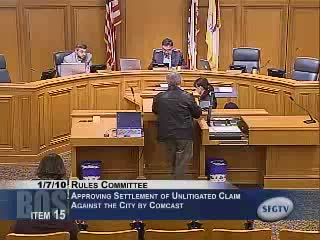
Heated public comment at Rules Committee on Comcast settlement and transition of public access to Bay Area Video Coalition
Summary
Dozens of speakers urged caution or support as the committee discussed accepting Comcast settlement funds and the city’s selection of the Bay Area Video Coalition (BAVAC) to operate public access channels; critics cited Market Street studio closure and missing operational plans, while BAVAC leaders defended the transition and highlighted doubled hours of service under constrained funding.
The Rules Committee set aside time on Jan. 7 for extensive public comment about a proposed acceptance of Comcast settlement funds that could support the city's public access channels. Deputy City Attorney Cheryl Adams told the committee the question before the Board would be whether to accept $375,000 from Comcast; the expenditure would be subject to later appropriation.
Opponents urged the committee to delay acceptance or to attach conditions. Steve Zeltzer of the Coalition for Free Speech and Community Access said the transfer to the Bay Area Video Coalition (BAVAC) had been nontransparent and criticized the closure of the Market Street station and a proposal he characterized as spending "over a million dollars" to build out studios that might later close; he asked the committee to hold off on accepting the settlement and negotiate further with the mayor's office and DTIS.
Several current and former public-access staffers and community producers described disruptions: a producer said studios were locked during the holidays and programming had lapsed, and another asked that capital funds for Market Street demolition be used to pay rent and keep that facility open.
BAVAC's executive director, Ken Ikeda, and BAVAC staff defended their record and said they had doubled studio hours and reopened equipment loan and training programs while operating on roughly one-sixth of prior funding. Ikeda said BAVAC took control on Sept. 1 and has worked to expand services "on roughly a sixth of the funding." He urged collaboration with community stakeholders and pledged to demonstrate sustained public-access service.
Tracy Rosenberg of Media Alliance asked the committee to postpone dispensing funds until BAVAC submitted operational plans required by its contract with the Department of Technology. "You don't dispense hundreds of thousands of dollars in public money without a plan in place," Rosenberg said, and pressed for documentation that BAVAC can meet contract requirements for programming hours and local production.
Other community speakers supported BAVAC, noting youth training, internships and classes and urging the city to provide financial support to sustain public access. The deputy city attorney later said the committee would continue discussions of item 15 at the call of the chair; committee members pledged to ensure funds meet city expectations before dispersal.