Get Full Government Meeting Transcripts, Videos, & Alerts Forever!
Get email alerts on the Government Ethics topic
No spam. Unsubscribe anytime.
Supervisors advance ban on city officers soliciting donations after hours of public testimony
Summary
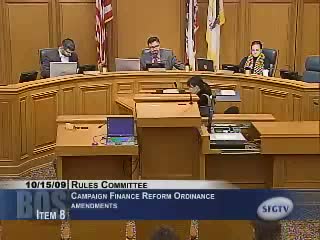
The Rules Committee advanced an ordinance restricting city officers and employees from soliciting donations to nonprofits that funnel funds back to city departments when donors have or will have business before those departments; the committee sent the measure to the full Board without a recommendation after heavy public testimony from arts, library and parks groups urging more tailoring and exemptions.
The San Francisco Rules Committee on Thursday moved an ordinance to the full Board that would bar certain city officers and employees from soliciting donations to nonprofits that then support their departments when three conditions are met: the officer reasonably expects the nonprofit will direct funds back to the department, the donor has had or is likely to have business before the department within 12 months, and the officer has supervisory or decision-making contact with the donor.
Supervisor Chris Daley, the ordinance’s author, said the measure is intended to prevent even the appearance of undue influence when large planning and contracting decisions are at stake. "When there's that much money at stake," Daley said during the hearing, "you just don't want people in positions to be soliciting funds from parties that have business before them." He framed the proposal as a narrowly tailored fix to limit situations that could create conflicts of interest.
Departments and nonprofit partners urged caution. Phil Ginsberg, general manager of Recreation and Park, warned the draft is not narrowly tailored and could chill donations and partnerships that help fill budget shortfalls. "This subjects the employee or officer to potential criminal charges for trying to support the Parks Trust," Ginsberg said, asking the committee to work on language that protects routine, legitimate fundraising partnerships.
City Librarian Luis Herrera and friends-of-the-library leaders told the committee that large efforts such as branch-furnishing campaigns and long-standing programs depend on partnerships and that the draft ordinance as written could have unintended consequences. "I would be very cautious to undertake any solicitation, even a thank you, for fear of what this would mean for me as a city official," Herrera said.
Supporters of the proposal pointed to reports of fundraising tied to departments such as Planning and argued that a rule is necessary to avoid appearances of pay-to-play. Daley acknowledged the concerns around smaller-scale permits and routine events and said he would work to refine the language; the committee ultimately advanced the ordinance to the full Board without a committee recommendation so the author can craft narrower exemptions.
Next steps: the item will be considered by the full Board, with the author and city attorneys expected to produce amendments to clarify the law’s scope and carve out departments or small, de minimis permits where the risk of undue influence is minimal.