Get Full Government Meeting Transcripts, Videos, & Alerts Forever!
Get email alerts on the Charter Budget Reform topic
No spam. Unsubscribe anytime.
Rules Committee advances package of charter budget amendments, tables or continues several items
Summary
The San Francisco Rules Committee reviewed a package of charter amendments on budget reform — including two-year budgeting, MOU deadlines, and financial policy thresholds — forwarding selected changes to the full Board and tabling or continuing other items after debate over scope and timing.
The San Francisco Board of Supervisors Rules Committee on Monday reviewed a package of charter amendments intended to reform the city’s budget process, forwarding some changes to the full Board while tabling or continuing several companion items.
Vice Chair Carmen Chu presented a set of proposed amendments to a ballot charter measure covering five main areas: the vote threshold required to adopt financial policies; timing and process for a two-year budget cycle; definitions for what constitutes a “significant” revenue or expenditure change; language on set-asides; and procedures for coordinating memoranda of understanding (MOUs) so that mayoral and Board budget decisions can account for labor agreements. “These changes were proposed based on the conversation last Thursday,” Chu said while walking the committee through the package.
The deputy city attorney and the city’s labor-relations manager described several specific edits proposed for the MOU sections. Under the changes, the deadline in subsection K of charter section A8409-4 would shift from an adoption-by-June 30 requirement to a May 10 (or May 15 if parties waive a 10-day cooling-off period) submittal date; language would be added making clear that an agreement adopted after the deadline that “reduces or has no net impact on the existing economic provisions” would be treated differently; and the automatic extension period for a rejected MOU would be shortened from 60 days to 30 days. The Department of Human Resources also reported that safety bargaining units asked to import a January 20 arbitrator-selection deadline into the safety section so arbitrator selection occurs earlier in impasse processes.
Supervisor Chris Daly urged a broader approach, saying the package did not include several structural reforms he considers necessary — including a mid-cycle “retrigger” if revenues fall short and more guaranteed deliberation time for the Board during a two-year cycle. “If you come up with a better mechanism, Supervisor, let me know,” Daly said, arguing he would not support the measure without stronger mid-cycle safeguards. Supervisor David Campos defended the proposal as a step toward addressing what he described as a “structural imbalance” that allows the mayor to withhold expenditures the Board has voted to fund.
On individual actions, the committee agreed to move several amendments forward: a motion to accept changes covering financial-policy thresholds, the two-year budgeting framework (page 7 of the draft), bargaining deadlines and official-advertising rules was made and acted on. A separate motion to remove set-aside language was called and the roll call was recorded as Supervisor Chu voting No, Supervisor Campos Aye, and Supervisor Daly Aye (reported as 2 ayes, 1 no). The committee voted to forward item 2 — a proposed charter amendment allowing the Board to designate certain appropriations as mandates — to the full Board with a recommendation (roll call: Chu No; Campos Aye; Daley Aye; reported 2 ayes, 1 no).
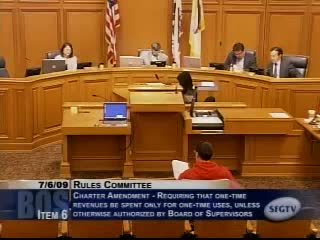
Several items were tabled or continued. Item 3 (creating an office of management and budget and related provisions) was tabled at a member’s request. Item 4 (the amended two-year budget-cycle language) was continued to Friday because amended items must sit for one week and cannot be heard until July 13. Item 5 was tabled as effectively disposed by the amendments made. Item 6 (requiring one-time revenues be spent only on one-time uses) was tabled after a roll call (same 2–1 pattern reported).
Committee members repeatedly emphasized the limited scope of the current package and noted that including more extensive mid-cycle corrections in the charter might jeopardize consensus. Several technical clarifications were extracted during the hearing: dates for the two-year cycle would be set by Board resolution (rather than locked into the charter); “significant” increases or decreases in revenues would be defined by resolution; and the clerk and Board would define “publishing” (official advertising) later by ordinance to allow adaptability over time.
The Rules Committee’s actions mean portions of the proposed charter reforms will now proceed to the full Board with recommendations, while other elements will be refined or delayed for further consideration.