Get Full Government Meeting Transcripts, Videos, & Alerts Forever!
Get email alerts on the Pier 70 topic
No spam. Unsubscribe anytime.
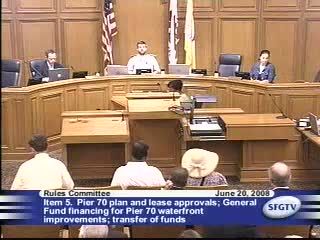
Rules Committee recommends Pier 70 charter amendment to full Board after port presentation
Summary
The Committee voted to recommend a charter amendment giving the Port additional tools (including a tax‑increment–style financing option using payroll/hotel tax growth) to fund Pier 70 remediation, historic rehabilitation, and waterfront open space, after a Port presentation describing costs and phasing.
The Rules Committee moved a Pier 70 charter amendment to the full Board with recommendation after a presentation from Port staff on the site's history, contamination, and financing needs.
Port staff described Pier 70 as a 65-acre central waterfront site with dozens of historic structures eligible for the National Register, active ship-repair uses and substantial environmental contamination and seismic retrofit needs. Staff said traditional port revenues, grants and tax credits will not be sufficient to remediate, retrofit and open the site to public uses and presented two optional tools: (1) the ability for the Board to approve a Pier 70 plan in lieu of certain later lease approvals, and (2) a financing tool patterned on tax-increment approaches that would first look to lease and property-tax revenues and then could capture up to 75% of projected payroll and hotel tax growth over a 20-year financing period as a 'last resort' financing source.
Port presenters explained that the master plan anticipates major capital costs and potentially thousands of new jobs at full buildout; they said the financing approach is intended to reduce entitlement risk and lower developers' required rate of return by providing a predictable financing package. The comptroller's office provided an early fiscal estimate and said preparing payroll/hotel‑tax projections would be a new task for the controller's office but is administratively feasible.
Public comment was mixed but leaned supportive: preservation advocates, neighborhood groups and park advocates favored restoration and public access; others raised concerns about public-trust land, historic preservation priorities and cumulative pollution near industrial uses.
The Committee unanimously moved the measure to the full Board with recommendation and added a cosponsor. The full Board will receive the amendment for further consideration; any use of the new financing tool would require additional findings and approval by the Board and coordination with state and federal funding programs.
Next steps: the charter amendment will advance to the Board of Supervisors and the Port and City staff will continue to refine the master plan and financing projections for review.