Get Full Government Meeting Transcripts, Videos, & Alerts Forever!
Get email alerts on the Housing topic
No spam. Unsubscribe anytime.
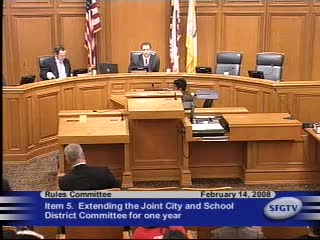
Rules Committee hears density-bonus initiative to create family-sized affordable units; supporters and neighborhood groups clash
Summary
The Rules Committee held a lengthy hearing on a voter initiative that would offer developers density bonuses, a 10-foot rear-yard setback allowance and planning-priority to produce larger inclusionary units. Supporters said it would keep families in San Francisco; opponents warned it could accelerate gentrification and questioned who would actually afford the units.
San Francisco — The Board of Supervisors Rules Committee held a hearing Feb. 14 on a proposed ballot initiative that would incentivize larger inclusionary, "family-sized" units by changing density controls, permitting a 10-foot rear-yard encroachment in parcels zoned up to 85 feet, and prioritizing planning review for qualifying projects.
Supervisor Bevan Dufty, sponsor of the measure, said the initiative is intended as a modest, voter-approved tool to increase family-sized below-market-rate units without costing the general fund. "This is what I believe will be a useful tool but a modest one that will offer more family sized units in San Francisco through a density bonus offered to developers," Dufty said, citing city statistics that show the majority of recent BMR units were studios or one-bedroom apartments and that the share of households with children has fallen over recent decades.
Anne Marie Rogers of the Planning Department outlined the initiative's three changes and explained how it would interact with existing neighborhood plans and development-impact fees. "This ballot initiative does 3 things to encourage larger, inclusionary housing units," Rogers said, and she told supervisors the initiative would not automatically negate development-impact fees because those fees are set by nexus studies and feasibility analyses.
Matt Franklin of the Mayor—s Office of Housing praised the focus on family housing but asked the committee to consider proportionality between private gain from lifted density controls and the public benefit of additional bedrooms. "I personally say I don't fully understand how that would work because the way I read the initiative, it very clearly says that all density is lifted," Franklin said, calling for clearer calibration or safeguards.
Public comment filled much of the hearing. Dozens of residents gave firsthand accounts of overcrowded apartments and families being priced out. "I have my children with me to prove that I can't afford to have them with me," said Stormy Henry, a Bayview resident who described living in a unit with three children. Advocates from the Children's Council, ACORN and the San Francisco Housing Action Coalition urged supervisors to move the proposal forward as one of several needed tools: Bryce Scofield of the Children's Council said the measure would help keep families in the city, and Tim Colon of the Housing Action Coalition said the developer-option approach and Mayor's Office control over unit assignment would help households who need family-sized units.
Neighborhood advocates and displacement groups raised sharp concerns. Nick Pagalatos of the Mission Anti-Displacement Coalition warned that the measure, as written, risks accelerating gentrification in neighborhoods already seeing heavy market-rate development. He noted that inclusionary ownership under current BMR rules often targets households earning 100–120% of area median income, which may be out of reach for many speakers at the hearing. "When we're talking about inclusionary units, what we're talking about is affordable ownership," he said, and urged more scrutiny of who would actually qualify.
Other critics, including organizers from the Mission and the Eastern Neighborhoods process, asked for more data on site-by-site proportionality and private windfalls to developers if density limits are lifted. Supporters replied that density bonuses are a commonly used tool in other jurisdictions and that the initiative would not cost the city money.
The Planning Department showed prototype examples to illustrate potential impacts: under one hypothetical, a parcel could shift from 9 to 16 units if the rear-yard and density incentives applied, a change speakers said could meaningfully increase property value and therefore require careful calibration of public benefit.
Supervisor Dufty acknowledged the concerns in his closing remarks and said he recognized the need to address proportionality, income targeting and other criticisms in ongoing dialogue. He noted the initiative will be before the voters and that further public debate is expected. The committee filed the item for the record and the matter will move into the public ballot process.
Next steps: the initiative was filed with the committee and will proceed to the ballot process, with further analysis and public debate expected on proportionality, eligibility criteria and interaction with neighborhood plans.