Get Full Government Meeting Transcripts, Videos, & Alerts Forever!
Get email alerts on the Nonprofit Funding Hiv Prevention topic
No spam. Unsubscribe anytime.
Supervisors hear pleas to save Aguilas as Latino HIV-prevention group faces shortfall
Summary
At a Rules Committee hearing, Aguilas leaders and dozens of clients and partners described evidence of program impact and warned that underfunding and a lost lease could force closure unless the city provides emergency support; the mayor’s office pledged to help find a solution.
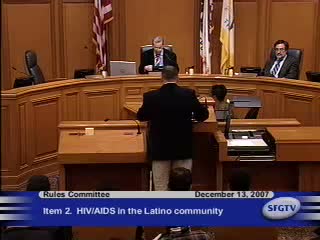
Supervisors and community members urged the San Francisco Rules Committee on Thursday to move quickly to prevent the closure of Aguilas, a culturally specific HIV-prevention organization serving Latino gay and bisexual men.
"This is a very significant issue," said Supervisor Tom Ammiano as he opened the informational hearing. He and other supervisors framed Aguilas’ work as central to reducing HIV risk among Latino men who have sex with men in San Francisco.
Dr. Eduardo Morales, introduced as Aguilas’ executive director, said the program has measurable impacts and is close to being recognized as an evidence-based practice by federal reviewers. "Somewhere between 40 to 70 percent" of participants showed reduced unprotected risk behavior between baseline and follow-up, Morales said, describing long-term evaluation efforts that predate current contract requirements.
Morales and other presenters said Aguilas has long delivered services beyond what its contract required but has been underfunded. Morales said the recent grant award was $243,000 per year while the actual cost of services exceeded $335,000, and added that the organization has lost its lease and "if we do not have a commitment to augment our funding, we will have to close the agency." Advocates asked for roughly $180,000 per year in additional support until new RFPs and federal funding become available.
Multiple current and former clients, staff and partner organizations described Aguilas’ bilingual, culturally tailored services as essential. "It is under Aguilas' wings where I have often come to find solace," said Juan Toledo, a long-time member, during public comment. Rodrigo Garcia, appearing for community partners, said Aguilas reaches more than 1,200 people annually and that closing its doors would also eliminate related community supports and social venues.
Speakers from partner agencies and program alumni requested that the city consider both immediate operating support and investment in infrastructure, including development capacity, to help Aguilas diversify revenue. "You need to look beyond that" single annual figure, said Eugene Delan, an El Ambiente coordinator, urging funding for organizational stability and staff who can pursue additional grants.
Alfredo Pedrosa of the Mayor's Office said the mayor "has my support and the support of the mayor" to help find a solution and described the forthcoming budget process as one venue for discussion. Supervisor Dufty and other supervisors committed to working with the mayor’s office and departments to explore options.
Deputy City Attorney Cheryl Adams also asked the committee to meet in closed session to discuss pending claims and litigation involving the city, citing Government Code section 54956.9 and San Francisco Administrative Code section 67.1(d).
The hearing was informational; supervisors expressed sympathy and pledged to follow up with the mayor and city departments to explore funding and administrative options. The committee did not adopt a specific emergency appropriation at the session, but members said they would continue discussions during the budget process and related meetings.