Get Full Government Meeting Transcripts, Videos, & Alerts Forever!
Get email alerts on the Sweatfree Ordinance topic
No spam. Unsubscribe anytime.
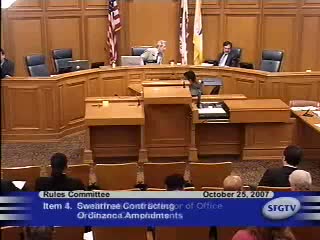
Rules Committee backs amendments to sweat‑free contracting to allow 'most compliant' awards when no fully compliant bids exist
Summary
The Rules Committee reviewed changes to the Sweatfree Contracting Ordinance that let the Office of Contract Administration award contracts to the bidder 'most substantially in compliance' when no fully compliant vendor exists, add contract conditions to drive improved compliance, and alter subcontractor reporting thresholds; committee forwarded the amendments to the full board with follow‑up on criteria and reporting.
The San Francisco Rules Committee on an extended agenda hearing reviewed amendments to the city—s Sweatfree Contracting Ordinance intended to make enforcement administratively feasible while preserving the ordinance—s labor standards. City Attorney Tom Owens said the changes would allow a purchaser, when no vendor is fully compliant, to award a contract to the bidder most substantially in compliance for up to two years, include contract conditions to promote greater compliance and terminate contracts if contractors fail to meet conditions.
Supporters of the changes, including Bill Jones of the Office of Contract Administration, said the original ordinance—s rigid checklist rendered many bids nonresponsive and prevented the city from procuring necessary garments and safety equipment; Jones estimated roughly six upcoming uniform/safety contracts with a combined value of about $1.8 million a year would be affected. He told the committee that the OCA would draft evaluation criteria in consultation with the Labor Standards Group and the Sweat Free Advisory Group and hold public hearings before applying a rating system.
Critics, including Senator Tom Hayden, warned the amendments risk a "backdoor retreat" from the ordinance—s standards absent enforceable compliance plans. Hayden urged time‑certain compliance plans and limits on long exemptions, warned that exempted contractors refusing to disclose factory locations would render monitoring ineffective, and recommended that any flexibility be accompanied by specific remediation milestones and short exemption durations.
The Sweat Free Procurement Advisory Group urged technical fixes to thresholds: Valerie Orth asked the committee to revisit a proposed $20,000 subcontractor threshold, noting many factories may fall below that level and requesting the advisory group further refine the definition. Manufacturers who addressed the committee offered plant visits and said some amendments are practical while noting privacy and proprietary constraints on certain disclosures.
The committee accepted that the draft needs work on rating criteria and reporting and moved to forward the ordinance amendments to the full Board of Supervisors with a recommendation, asking staff to return with clearer evaluation standards, a process for compliance plans/conditions and periodic reporting (committee requested quarterly or semiannual updates). The amendment package retains prohibitions and adds administrative mechanisms intended to reward relative compliance while providing termination rights if contractors do not meet agreed conditions.