Get Full Government Meeting Transcripts, Videos, & Alerts Forever!
Get email alerts on the Elections topic
No spam. Unsubscribe anytime.
Elections director outlines November plan after Secretary of State conditions; committee tables funding request
Summary
The director of elections told supervisors that Secretary of State conditions will prevent polling‑place equipment from producing ongoing results on election night, requiring ballots to be returned to City Hall for inspection and manual audits; the committee tabled any supplemental funding request until after the election.
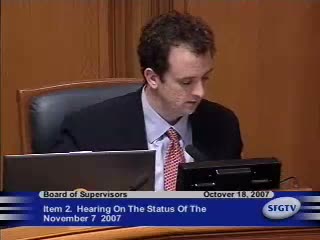
The Director of Elections, John Arndt, told a Board committee that the Secretary of State imposed conditions on the county’s voting system that prevent the use of polling‑place equipment to tally official or unofficial results on election night.
Arndt said the department mailed about 135,000 permanent absentee ballots and distributed voter guides; early voting at City Hall began Oct. 9. Under the Secretary of State’s conditions, ballots cast at polling places must be transported to City Hall, visually inspected for proper marking devices, and processed centrally rather than tallied at polling sites.
To provide confidence in machine counts, the Secretary of State required manual audits that Arndt said include a hand review of 10% of precinct polling‑place cards and 25% of absentee ballots. The audits and extra processing increase staffing needs and cost, and Arndt estimated additional, preliminary staffing and processing costs in the range of $300,000. He said ES&S had provided two extra card readers and transported AutoMark units from Contra Costa but had notified the city it would not reimburse personnel costs.
Arndt said the department’s goal was to have about 75% of polling‑place ballots counted by the Friday after the election and to provide substantial results within a few days. He cautioned that if manual audits and machine counts do not match, the department may need to expand the manual tally — potentially to a full hand count — and that he would seek an exception to the state’s 28‑day deadline if necessary.
Public commenters at the hearing — including election‑integrity advocates, open‑source proponents and civic groups — urged the city to pursue open‑source voting software in future procurements and welcomed audits to ensure accuracy. After discussion, the committee agreed to table any supplemental funding request and revisit staffing and costs after the election.