Get Full Government Meeting Transcripts, Videos, & Alerts Forever!
Get email alerts on the Shelter Standard Of Care topic
No spam. Unsubscribe anytime.
Shelter monitoring panel presents draft ‘standard of care,’ urges guaranteed hygiene, longer stays and better data
Summary
The Shelter Monitoring Committee told the Rules Committee it conducted 28 site visits and received 129 complaints this quarter and proposed a draft standard of care that includes guaranteed toilet paper and soap, minimum sleep hours, better vacancy tracking and 24-hour reservation access; city agencies said they will begin limited implementation with $300,000 in add-back funds.
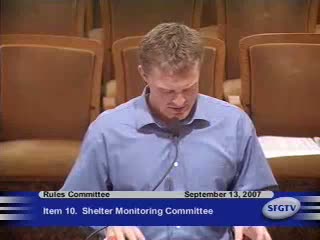
Quentin Mecki, Secretary of the Shelter Monitoring Committee, told the City and County of San Francisco Rules Committee that the committee conducted 28 site visits this quarter and continues to find basic hygiene shortfalls at city-funded shelters.
"We conducted 28 site visits in the quarter, and did 100% of the sites currently in operation," Mecki said, and added that inspectors still find "a lack of immediate access to hygiene products, toiletries such as toilet paper, soap, and towels." The committee reported 129 complaints in the quarter, with 33% concerning staff conduct, 14% facility issues and 12% nutrition.
The committee presented a consensus-driven draft standard of care developed by a five-month work group of shelter residents, providers, advocates and city staff. The draft groups recommendations under facility, operations and health-and-hygiene standards. Key facility proposals include a roving maintenance position to address urgent repairs, secure client storage and prioritized electrical outlets for medical devices. Operational recommendations include 24-hour access for shelter reservations, funding for at least one 24-hour emergency drop-in center providing medical and transportation services, and a policy to issue reservations for a minimum of seven nights to improve stability for clients.
Mecki also urged a minimum operating standard that would allow at least eight hours between lights out and wake time, saying, "By the time someone gets out to Providence in the Bayview at 11:45, they're then woken up at 6AM. They may not get to bed ... and then are asked to leave at 6AM." The draft recommends 12-hour operations at shelters that choose to be 24-hour sites so clients can realistically obtain eight hours of rest.
On health and hygiene the draft calls for guaranteed toilet paper and soap in bathroom stalls, hand dryers or towels, hand sanitizer access, feminine hygiene supplies on request, safe refrigerated medication storage, nutritionist-reviewed meal plans and clean bedding in plastic sleeves for city-funded shelters. Mecki noted a July add-back of $300,000 to the Department of Public Health and said the committee and DPH are discussing how far that money will go toward initial steps such as installing soap dispensers and hand dryers.
An HSA representative told the committee that staff have participated in the work group and will provide formal comments after internal review. The representative said supplies have been ordered and the agency is "working on" installing hand dryers and soap dispensers at family and single-adult shelters as an initial implementation step.
Public commenters who participated during the meeting urged quick adoption. Thomas Picariello, a member of the shelter-monitoring work group, said the city pays more when it does not provide basic hygiene: "By doing nothing, you are costing the city and county millions of dollars," Picariello said, citing hospital treatment costs for preventable infections. Longtime committee member Judy Ronnie described repeated encounters with shelters that lack basic supplies and urged the committee's recommendations be implemented.
Mecki and committee members acknowledged limits: the Shelter Monitoring Committee can make reports and recommendations but has no enforcement authority. Mecki said converting the draft into enforceable contract language or legislation will require city attorney review, funding commitments and additional staffing.
Next steps identified at the meeting included HSA and DPH formal comments to the committee, further review by the Rules Committee and staff work to translate the consensus draft into legislative or contractual language. The committee expressed willingness to assist with streamlining the drafting and implementation process.
The Rules Committee did not adopt the draft as legislation at this meeting; members and city staff described the draft as a consensus blueprint the city will need to fund, convert to legal language and phase in over time.