Get Full Government Meeting Transcripts, Videos, & Alerts Forever!
Get email alerts on the Library Funding Charter Amendment topic
No spam. Unsubscribe anytime.
Supervisors Hear Broad Support and Concerns as Charter Amendment to Renew Library Preservation Fund Is Refined and Continued
Summary
A Board of Supervisors committee heard testimony for and against a proposed 15-year renewal of the Library Preservation Fund that would also allow revenue bonds; sponsors introduced amendments to cap how much of the set-aside may pay debt service, and the committee adopted amendments and continued the item to a subsequent meeting for final action.
SAN FRANCISCO — The San Francisco Board of Supervisors’ committee took public testimony and refined a first-draft charter amendment on Wednesday that would renew the Library Preservation Fund for 15 years and allow the city to issue debt secured by that dedicated property-tax set-aside.
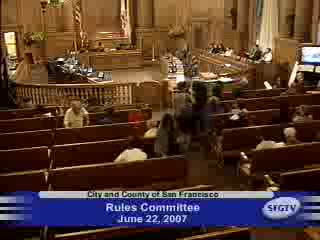
Chair Supervisor Tom Ammiano opened the hearing after the clerk read Item 1, which would repeal and replace section 16.109 of the charter to renew the fund and authorize revenue bonds or other indebtedness to be secured by or repaid from the set-aside. Library staff and community members described both the program’s record and outstanding questions about oversight and the proposed debt authority.
Luis Herrera of the San Francisco Public Library summarized Prop E’s impact, saying, “The passage of proposition e has played a key role in stabilizing the library's funding and enabling the library to significantly improve its services and collections.” Herrera told the committee that Prop E has supported an expansion in hours, staff and materials, and that the branch renovation program (BLIP) has delivered several new and renovated branches but faces an estimated $44 million to $52 million shortfall to finish remaining projects.
Sponsor Supervisor Aaron Peskin said he will offer an amendment of the whole responding to letters from individuals and organizations. “I am offering language today that would limit the amount of the set-aside that could be spent on debt repayment,” Peskin said, previewing the chief change supporters and critics had sought: a cap that would prevent the annual set-aside from being overly diverted to pay bond debt at the expense of operating hours and services.
Deputy City Attorney Mike Martin explained how the proposed cap would work: the added language would tie a limit on annual debt-service payments to growth in the annual set-aside over a base fiscal year (2006–07), so only the excess above that base could be used for debt service. Deputy City Attorney Franchesca Gessner later told the committee the amendment does not change existing charter fiscal provisions and that library expenditures would remain subject to the charter’s budgetary rules.
Public comment ran more than an hour and reflected broad support for preserving library funding alongside strong requests for oversight and spending constraints. Supporters — including longtime Prop E organizers, the Friends of the Library and union representatives — emphasized the fund’s role in expanding hours, collections and public-technology access. "It's been inspiring today to hear so many people talking about their commitment to ensuring that our libraries remain exciting, healthy, and fabulous places for all of these explorations," said Anne Wintrobe of Friends of the Library.
Opponents and skeptics urged caution. Peter Warfield of the Library Users Association said the measure, as drafted, "is a potential disaster for the library's operating funds" and warned it could reduce Board and public budgetary accountability; he urged the committee to allow the controller's ongoing audit of the BLIP program to be completed before renewing the set-aside. Several speakers requested clearer ballot language stating that the measure would allow revenue bonds and recommended creating or clarifying oversight mechanisms for the bond proceeds.
Library finance staff defended the plan’s feasibility. Jay Manglik Mott, finance director for the San Francisco Public Library, said staff had modeled conservative revenue projections and that the library "can afford certain amount of revenue bonding" under those assumptions.
After public comment, supervisors discussed the amendments and legal implications. Deputy City Attorney Franchesca Gessner said the amendment preserves the charter’s fiscal oversight: "There is no change from the existing law under the charter amendment... The money's there and shall be expended or used solely by the library department subject to the budgetary and fiscal provisions of the charter." Supervisors indicated they adopted the amendments that had been introduced and, because of noticing requirements, continued the item for further consideration at the committee’s next meeting (the matter was scheduled to return on July 5).
What the committee did not do was take a final vote on the substantive charter text. The next steps are completing final amendment language, reviewing any technical edits from the city attorney, and returning to the Board for a final committee report and potential placement on the November ballot. The committee also discussed notice/advertising constraints and scheduling options before adjourning.
—
The committee hearing included a mix of institutional testimony (library staff and finance), organized-support voices (Friends of the Library; SEIU; Library Citizens Advisory Committee), community members recounting neighborhood impacts, and critics urging stronger spending controls and delay until the controller's audit is completed. The committee’s immediate action was procedural: adopt the sponsor’s amendments as introduced and continue the item to allow final legal and scheduling steps.